Wednesday, January 28, 2026 | 12:01 AM ISTहिंदी में पढें
Business Standard
Notification Icon
userprofile IconSearch

A big deal: The India-EU partnership will open up new opportunities

India and EU seal historic free trade deal, opening vast markets and cooperation avenues while urging India to boost competitiveness and reforms
Modi, Narendra Modi, Antonio Costa, Ursula von der Leyen, Ursula, von der Leyen, Leyen
premium

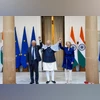
New Delhi: PM Narendra Modi with European Council President Antonio Costa, left, and European Commission President Ursula von der Leyen, right, during their meeting at the Hyderabad House, in New Delhi, Tuesday, Jan. 27, 2026. (Photo: PTI)

Business Standard Editorial Comment Mumbai

Listen to This Article

India and the European Union (EU) on Tuesday concluded the much-awaited free-trade agreement (FTA), one of the largest of its kind globally in recent times. The deal will create a market of two billion people. Nevertheless, the 16th India-EU summit and the engagement of leaders from both sides were not limited to trade. Several other agreements were signed to increase cooperation and strengthen relations. Both sides, for instance, have prepared an overarching document covering all aspects of the India-EU strategic partnership. India and the EU will improve cooperation on defence and security. A comprehensive framework for cooperation on mobility has also been agreed upon. Both India and the EU will open up several sub-sectors in the services space to accommodate each other’s priorities. The EU has also committed itself to post-study work visas for Indian students. 
In the context of the trade deal, though it will get operationalised after the legal requirements are completed, what has been achieved is remarkable. In 2024-25, India-EU bilateral trade was worth $136.54 billion. India exported goods worth $75.85 billion during the year while imports were at $60.68 billion. Trade can increase rapidly, given the scale. India and the EU account for 25 per cent of global gross domestic product and about a third of global trade. Both sides also have large trading relations in services. It has been agreed that the EU will liberalise tariffs on 99.5 per cent of goods imported in terms of value from India, while India will liberalise duties on over 92 per cent of tariff lines. India will bring down tariffs to zero on 30 per cent of trade by value as soon as the agreement comes into force, and the scope will be gradually increased. Notably, the EU has not given an exemption on the Carbon Border Adjustment Mechanism (CBAM). However, it has agreed that the flexibility given to any other country will be extended to India. 
Although the finalisation of the FTA is an achievement and a reaffirmation of commitment from both sides to a rules-based global order, India should not lose sight of at least three important issues. First, this is not a substitute for a trade agreement with the United States (US). The US administration is still sending mixed signals, but India must continue its efforts to arrive at a mutually beneficial agreement. The possibility of losing access to the US market for an extended period must be avoided. Second, India needs to review its trade policy in general, and tariffs need to be brought down significantly. Since India has shown significant openness to Europe, dropping tariffs in general should be relatively easy now. The upcoming Union Budget will be an excellent opportunity to start the process in a meaningful way. It also needs to reassess quality-control orders, which are essentially trade barriers. 
These are important if India is to become part of global value chains in a meaningful manner. It should also now actively consider the possibility of joining mega-regional trade arrangements like the Comprehensive and Progressive Agreement for Trans-Pacific Partnership. Third, India must now push internal reforms more aggressively. It will be able to take advantage of trade deals only if Indian businesses become more competitive. One common criticism of FTAs is that they don’t benefit Indian businesses. This happens because of competitiveness. Internal reforms can help avoid such outcomes in the future.