


BS Samriddhi: Uttar Pradesh racing ahead on all fronts, says Pathak
With sharper focus on infrastructure, industry, MSMEs and policy delivery, the Yogi Adityanath government aims to make Uttar Pradesh a $1 trillion economy and boost India's $5 trillion goal
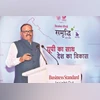 "Uttar Pradesh Deputy CM Brajesh Pathak speaks at Business Standard's Samriddhi programme in Lucknow about the state's progress")
premium
Uttar Pradesh Deputy CM Brajesh Pathak speaks at Business Standard's Samriddhi programme in Lucknow about the state's progress
10 min read Last Updated : Dec 30 2025 | 6:05 AM IST
Listen to This Article
Uttar Pradesh is demographically the country’s youngest state, with 56 per cent of its population — 240 million — in the working-age.
The state government is working to leverage this advantage by strengthening law and order and rolling out policies whose impact is visible in sectors such as finance, infrastructure, transport, tourism, health care, and education.
Ministers, senior officials, academics, and policymakers who participated in Business Standard’s “Samriddhi” — a programme in Lucknow — said robust law and order, coupled with people-centric policies, had accelerated the state’s all-round development.
Deputy Chief Minister Brajesh Pathak laid emphasis on law and order. He said that no investor or businessman would even consider a state where law and order was weak.
Pathak said the biggest challenge for the government, when the Bharatiya Janata Party (BJP) came to power, was infrastructure development, for which revenues were needed. But, revenue would come only if law and order had improved.
However, in contrast the state was in the grip of criminal gangs and anarchy. Not just that, basic amenities such as electricity, mid-day meal for children, and road infrastructure were in a shambles.
“Our government gradually transformed each one of them in the past more than eight years and slowly law and order improved, and work was done on basic amenities such as roads, electricity, schools and hospitals, which resulted in an all-round development of the state,” Pathak said.
He said owing to all this enrolment in schools rose from 11.2 million to 19 million, mafias were controlled, and around 800,000 government jobs were created and given by fair means.
“The number of medical colleges, government and private, in the state has doubled to almost 81. Of those, more than 40 were just added in the last eight years,” Pathak said.
The number of primary health centres, district hospitals, and community health centres too showed an exponential rise.
“We are providing almost 400 medicines free of cost in state-government health centres, which, In 2017, those numbered just a few hundred,” Pathak said.
‘Strong infrastructure backbone’
Uttar Pradesh has witnessed significant infrastructure development over the past eight-nine years. The government data shows major progress in roads, especially expressways. The Agra-Lucknow Expressway, with a length of about 302 km, is among the longest in the country.
The Ganga Expressway, which will connect major export hubs and corridors, will be 603-km-long and is expected to become the longest expressway in India. The Purvanchal and Bundelkhand Expressways have made the movement of goods from export centres in eastern Uttar Pradesh and Bundelkhand easier.
“Today Uttar Pradesh has the largest rail network in the country and the second-largest road network. The state accounts for 37 per cent of India’s expressway network, and our target is to raise this to 50 per cent by 2047,” he said.
Highlighting the development of airports, Pathak said a $1 trillion economy (for Uttar Pradesh) could not be achieved without strong connectivity. That is why the government is working to improve connectivity by land, water, and air.
At present, Uttar Pradesh is moving ahead with sixteen operational airports. The state already has four international airports, and a fifth one — Jewar airport — is set to begin operations soon.
Similarly, in waterways, Uttar Pradesh is far ahead, with the country’s first inland waterway starting from Prayagraj and extending to Haldia port in West Bengal via the Ganga.
The country’s first multimodal terminal on this waterway has been built in Varanasi, and 10 waterways are expected to further transform the state. Owing to improving connectivity through roads, railways, and waterways, investment in Uttar Pradesh has surged.
On power supply, the deputy chief minister said time was when the state suffered from severe power shortages. Visitors would often ask whether electricity cuts occurred at night or during the day.
“Our government pulled the state out of that embarrassing situation. Today, people can hardly remember when the last power cut happened,” he said. This has benefited not only the general public but also industries, which no longer need to spend heavily on diesel generators. Reduced costs have significantly improved their profitability.
‘Large population, greater strength’
Due to its large population, Uttar Pradesh is also the biggest consumer market in the country, making it attractive for companies and businesses.
Earlier, while inaugurating the programme, State Minister for Excise and Prohibition (Independent Charge) Nitin Agarwal said before the BJP came to power, his department generated excise of around ₹14,000 crore. In 2024-25, excise revenue rose to ₹52,573 crore, and it is expected to reach nearly ₹63,000 crore by the end of 2025-26.
Uttar Pradesh has now become the leading state in molasses and ethanol production, he added.
Agarwal said that such initiatives and policies had turned Uttar Pradesh into the country’s “growth engine”. He recalled that when the BJP government took office in 2017, the state faced enormous challenges — low gross state domestic product (GSDP), weak manufacturing, inadequate infrastructure, lack of investment, and poor law and order.
“As a result of the government’s efforts, Uttar Pradesh’s GSDP has grown from ₹13.30 trillion in 2017 to ₹30 trillion today, and it is expected to reach ₹35 trillion by the end of this financial year,” he said.
‘Supportive and targeted policies’
Chief Minister Yogi Adityanath’s emphasis on industry is well known. As the state with the third-largest economy in India and a contributor of over 8 per cent to national gross domestic product, Uttar Pradesh needs robust industrial policies.
The data shows that exports from the state are growing at an annual rate of 18 per cent. They were $21 billion in 2023-24, and the government aims to raise this to $50 billion by 2029-30 through the Uttar Pradesh Export Promotion Policy 2025-30, which seeks to position the state as a global export hub.
Agarwal noted that the number of industrial units in the state had risen from around 13,000 in 2017 to 27,295 today. Entrepreneurs from other states and abroad are coming to Uttar Pradesh, giving local, small entrepreneurs and the overall industry greater market access.
Employment has grown rapidly, with the unemployment rate falling from 6.8 per cent in 2017 to just 2.4 per cent in 2025. Of the jobs created, nine million have come from micro, small, and medium enterprises (MSMEs).
Looking ahead to a developed India by 2047, Agarwal said the state must place even greater emphasis on manufacturing. Currently, manufacturing accounts for 15 per cent of Uttar Pradesh’s GSDP, and the government aims to raise this to 35 per cent by 2047. This will require industry to grow at an annual rate of 10 per cent, and the government is making every effort to achieve this.
‘Rising employment opportunities’
According to the data from the “Invest UP” portal, a sustained focus on electronics manufacturing has led to the establishment of factories by companies such as Samsung and Oppo in and around Noida. This year, the state implemented the Uttar Pradesh Electronics Components Manufacturing Policy 2025.
In addition, the state has introduced a semiconductor policy on the lines of the Centre’s, offering subsidies on capital and interest, land at concessionary rates, and exemption on stamp duty and registration charges to manufacturers.
Today BrahMos missiles are being manufactured in the state due to emphasis on defence clusters, Agarwal said, adding that the Prime Minister recently announced the setting up of a textile cluster between Lucknow and Hardoi, and similar clusters are being planned for leather, footwear, and health care.
Speakers at the programme highlighted other achievements of the state government. Uttar Pradesh ranks second in the country on ease of doing business and continues to improve. The Investment Mitra portal, launched by the state government, is regarded as one of the largest single-window clearance systems in India.
The government has framed policies for more than 20 sectors. Uttar Pradesh has the highest number of MSMEs in the country, largely due to the Udyami Mitra Scheme, launched in 2023.
‘Transforming transport’
There was discussion on the rapid growth of the transport and tourism sectors. Transport Minister Dayashankar Singh said the Uttar Pradesh State Road Transport Corporation, once in poor condition, was now among the few profitable transport corporations in the country and had been earning profits for the past two financial years. He said his goal was for the corporation to have fixed deposits of at least ₹10,000 crore by 2027, when the government’s term ends, ensuring long-term financial stability.
He said private-sector participation had been the key to this transformation — whether in depot modernisation, connecting nearly 13,000 villages with regular bus service, or running electric buses, which is reducing pollution. To improve connectivity in underserved areas, tenders have been issued for 1,540 new routes, with active participation from the private sector.
Singh said that earlier policies offered private operators only three-year leases, charged 2 per cent rent, and did not allow borrowing, which created difficulties. These policies were changed promptly. Now, private transport companies receive 90-year leases, pay only 0.5 per cent rent, and are allowed to take loans. For electric buses, the transport department retains only 3 per cent of profits, with the rest going to the private operator, while government conductors ensure operational control.
The construction of the Ram Temple in Ayodhya, the Kashi Corridor in Varanasi, and the development of heritage sites in places such as Lucknow and Sonbhadra, have increased tourist inflows.
Tourism Minister Jaiveer Singh said improved law and order had been the foundation of this transformation, supported by tourist-friendly policies.
He noted tourism was one of the few sectors where one direct job created six additional jobs in allied fields such as hotels, food, and transport. To encourage entrepreneurship, the government offers a 25 per cent subsidy not only for five-star hotels but also for small homestays, along with land subsidies and time-bound clearances. Singh expressed confidence that with strong infrastructure, law and order, and growing tourist destinations, tourism would become one of the largest contributors to state revenue.
During panel discussions, officials highlighted new industrial areas and MSME opportunities, stressing that livestock-based activities and rural cottage industries were key drivers of growth.
The government is focusing on dairy processing, poultry, and fisheries, while increasing credit allocation to support rural areas and small enterprises. Experts also appreciated the government’s emphasis on a circular economy to balance infrastructure development with environmental sustainability, citing examples such as the use of crop residue for power generation and fly ash in road construction.
Together, these initiatives underscore how Uttar Pradesh is charting a rapid and comprehensive path towards becoming a $1 trillion economy.