


Japan is living in future; builds 3D printed train station in just 6 hours
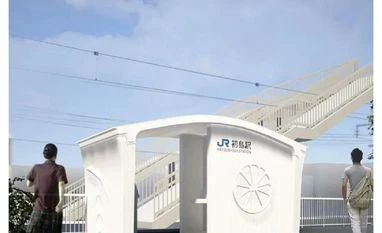
According to a NYT report, the components of this station were 3D-printed somewhere else and were assembled on the site at Hatshushima in March 2025, making it the world's first
 "Japan 3D printer, 3D printed train station")
Photo: West Japan Railway Group
Listen to This Article
Hatsushima Station, a relatively not-so-busy station in Japan’s Arida town, serving 530 riders per day, was due for a replacement of a weathered wooden complex, and in just six hours, it got a replacement no one was expecting. The workers in Arida replaced the wooden structure with a 3D-printed station just after the last train and before it was time for the first train of the next day.
According to a New York Times report, the components of this station were 3D-printed somewhere else and were assembled on the site at Hatshushima in March 2025, making it the world’s first. The West Japan Railway Company, a major railway operator, was responsible for this feat and unveiled it. It claimed that while the current station may look more like a shelter, constructing a new one traditionally would have cost twice and would have taken over two months.
How was the station built?
The West Japan Railway Company was able to achieve this feat with the help of a construction company, Serendix, which was hired to build the components of this 3D-printed station. The company said that in just seven days, it was able to print the parts and reinforce them with concrete. It was done at a factory in Kumamoto Prefecture on Kyushu island. On March 24, these parts left the factory and were transported 500 miles by road to Hatsushima station.
Kunihiro Handa, Serendix co-founder, stated that construction usually takes place over several months, while the trains are not running every night. However, he further added that the construction work near the commercial lines is generally carried out at night, so that the train schedules are not disrupted.
Also Read

 "Defense Minister Gen Nakatani, Japan")
 "Yen, Japan Currency")
 "National Stock Exchange, NSE")
 "Asian market, Asian stocks")
The report added that these parts, which were pre-printed, were made of special mortar and separate trucks were used to deliver them, after which a crane brought them down, where they were assembled by the workers. The West Railway Company expects to open the new building in July, since the station still needs interior work along with the equipment, like ticketing machines.
Why is this significant?
This comes at a time when Japan’s workforce is shrinking, and its population consists of old and ageing individuals. These two factors make the maintenance of railway infrastructure a major issue for railway operators. Officials predicted that the world’s first 3D-printed station could help in addressing the problem with newer technology and fewer workers.
3D print projects in India
In February this year, Godrej Properties unveiled India’s first 3D-printed G+1 villa at Godrej Eden Estate, Maan Hinjewadi, Pune, in collaboration with Tvasta Engineering. The companies use additive manufacturing techniques to construct these villas. Recycled materials from several industries, including construction waste, are used, thereby reducing the environmental footprint.
How is 3D printing done?
According to Tvasta Engineering, here’s how 3D construction printing is done:
The process begins with creating a digital design of the structure using computer-aided design (CAD) software, which acts as the blueprint for the 3D construction equipment. Following this, specialised construction material is mixed and prepared to be used in the printer.
A 3D printer, equipped with a nozzle, follows the instructions and deposits layers of construction materials. These layers are usually laid in zig-zag or grid patterns.
The construction then continues layer-by-layer, with each layer adding to the previous one through mechanical bonding. Once the printing process is complete, the structure undergoes curing to strengthen its material.
More From This Section
 "China Russia flag")
 "pakistan Flag")
 "US Senate")
 "Elon Musk, DOGE, Tesla CEO")
 "Donald Trump, Adam Schiff")
Topics : Japan 3D printing BS Web Reports
Don't miss the most important news and views of the day. Get them on our Telegram channel
First Published: Apr 09 2025 | 3:22 PM IST