
PV retail sales dip 4% in Jan as semiconductor shortage impacts vertical
Automobile dealers' body FADA on Tuesday said passenger vehicle (PV) retail sales in January witnessed a year-on-year decline of 4.46 per cent to 2,81,666 units
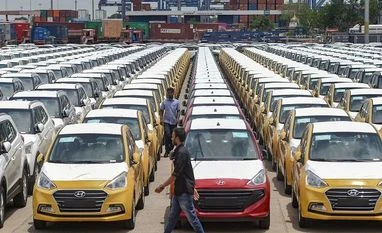 "PV retail sales dip 4% in Jan as semiconductor shortage impacts vertical")
WebinarsNew
Deep DiveNew
Explore Business Standard
Automobile dealers' body FADA on Tuesday said passenger vehicle (PV) retail sales in January witnessed a year-on-year decline of 4.46 per cent to 2,81,666 units
Automobile dealers' body FADA on Tuesday said passenger vehicle (PV) retail sales in January witnessed a year-on-year decline of 4.46 per cent to 2,81,666 units, as semiconductor shortage impacted the segment.
According to the Federation of Automobile Dealers Associations (FADA), which collected vehicle registration data from 1,273 out of the 1,480 regional transport offices (RTOs), PV sales stood at 2,94,817 units in January 2020.
Two-wheeler sales declined 8.78 per cent to 11,63,322 units last month, as compared to 12,75,308 units in January 2020.
Commercial vehicle sales also slipped 24.99 per cent to 55,835 units, as against 74,439 units a year ago.
Similarly, three-wheeler sales fell 51.31 per cent to 31,059 units last month, from 63,785 units in the year-ago period.
Tractor sales, however, grew by 11.14 per cent to 60,754 units last month, against 54,662 units in the same month the previous year.
Total sales across categories declined 9.66 per cent to 15,92,636 units last month compared to 17,63,011 units in the year-ago period.
Commenting on the sales data, FADA President Vinkesh Gulati said after witnessing a one-off growth in December, January registrations fell once again by 10 per cent year-on-year.
"Auto industry clearly misjudged the demand which returned post lockdown. Industry's underestimation of postcovid rebound along with chipmakers prioritising higher-volume and more lucrative consumer electronics market has created a vacuum for semiconductors," he noted.
This has resulted in a shortage in supply for all categories of vehicles, especially passenger vehicles, even though enquiry levels and bookings remained high, Gulati said.
Semiconductors are silicon chips that cater to control and memory functions in products ranging from automobiles, computers and cellphones to various other electronic items.
The usage of semiconductors in the auto industry has gone up globally in recent times, with new models coming with more and more electronic features such as Bluetooth connectivity and driver-assist, navigation and hybrid-electric systems.
Gulati said the recent price hike is undertaken by companies and added to woes as two-wheelers have become more expensive for lower and middle-income classes. Similarly, commercial vehicle registrations were also hit due to vehicle financing still not back to average and high BS-VI cost, Gulati said.
"With a high base and continued shortage of semiconductors on the one hand and the gradual opening of academic institutes and business as usual along with COVID vaccine's effectiveness on the other, FADA continues to remain guarded in its optimism for auto registrations during the fourth quarter of this financial year," he added.
(Only the headline and picture of this report may have been reworked by the Business Standard staff; the rest of the content is auto-generated from a syndicated feed.)
First Published: Feb 09 2021 | 2:59 PM IST


 Connect with us on WhatsApp