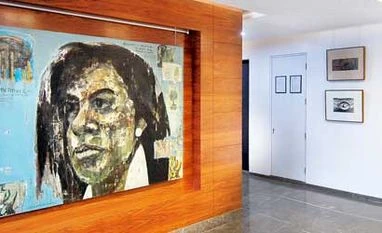
It comes across as an unusual art exhibition in a strange-looking space. The works are spread around a couple of halls, pillars, cafeterias, obscure corridors and within nearby rooms. There are no glasses of wine or delicate portions of cheese. Many people are present but none of them gather in small clusters to gaze at or discuss the paintings. Instead, while pieces by S H Raza, Bhupen Khakhar and Krishen Khanna hang a few metres away, they diligently pore through Excel sheets on computer screens or chat over cups of vending-machine coffee.
This is, in fact, not a gallery but two floors of the Deutsche Bank office in Bandra-Kurla Complex, where most of the 300-odd works owned by the Indian arm of the German financial company are displayed. Unlike the India headquarters, Deutsche House in Fort, a gorgeous historic structure that was bought from the Tatas in 1992, this building in the suburbs is a rather uninspiring glass giant. It does, however, offer spectacular views and consolidation of the bank's artworks in this campus over the last six months has lent it vibrancy.
At the entrance of the fifteenth level, a Jitish Kallat piece from his student days with a quirky mix of prints and paint draws attention instantly. Thereafter, it takes two full hours to trail the art including paintings, mixed media, metal art and statues by well-known artists like Sudhir Patwardhan and Sudarshan Shetty, and lesser-known names like V Ramesh and Anita Dube. Onerously, there are no information tags yet as the bank plans to keep moving pieces until they fit perfectly into spots. "We also have plans to receive art from our banks in other countries on rotational basis. That way the collection is never static, it breathes," says Reshma Ghoshal, vice-president, group communications and CSR, Deutsche Bank India.
* * *
The bank owns 50,000 pieces globally, making it the largest corporate collector of art. These are not for investment purposes, says Ghoshal, but for "engagement" with employees and customers. While most companies confine art to the cabins of top management, she adds, these pieces are found in common spaces as this is expected to encourage creativity. The placement of some pieces is ideal, for instance, a series by German artist Elsbeth Arlt,
Only a glass of wine, is aptly placed in the common dining area.
There is a mix of Indian, German and quasi-German art, with 35-40 per cent of the repertoire consisting of international works. Tyeb Mehta's
Trussed Bull and
Bindu by Raza, which brings alive the white wall of CEO Ravneet Gill's room, are among the costliest paintings. One of the rare finds is parts from a 1977 series by Indian sculptor Somnath Hore called
Wounds which conveys the pain of the Bangladesh partition. The work of German artists Konrad Klapheck, who makes detailed drawings of machines; and George Baselitz, known for displaying his paintings upside down, are revelations.
* * *
Busy work hours may not allow employees to rave about the surrounding beauty but they have quietly formed preferences. "Whenever we change the location of works, it is noticed. They ask why or request us not to move them. Clearly there is a subconscious engagement with art," says Ghoshal. It is not uncommon for the senior management to fight over favourite pieces. Conversely, much to the surprise of colleagues in Frankfurt, a set of works by Swiss painter Miriam Cahn depicting hazy black-and-white forms was disliked by most employees here as they looked like skulls.
Much of the Indian collection was acquired between 1994 and 2000. The stress has been on buying young, that is from emerging artists in the early or middle stages of their careers. Several years after the works were purchased, many artists went on to become big names. Some, it is said, returned to borrow paintings for their solo exhibitions. As it follows, the modernist and contemporary works are worth a lot more today than the prices at which they were bought. The bank does not divulge the worth of the art because selling is not on its mind.
It takes special care to maintain such a large collection. Any decision on acquiring, rotating and shifting art is taken in consultation with an international art team that sits in Frankfurt. The bank enlists the help of art conservation consultant Anupam Sah to assess the health of the pieces. All art works are placed in access-controlled areas with CCTV monitoring and security guards. They are insured, inventorised and counted each week. The surroundings are kept air-conditioned and free from strong sunlight.
The idea behind the consolidation in Bandra-Kurla is to increase interaction with the public, says Ghoshal. It will make it easier to conduct art walks for clients and students, all set to begin before the year-end.

 "Art vault")


 Connect with us on WhatsApp