Each one of us is familiar with the sword hanging over our heads: The deadline. While some of us are terrified of it, others thrive when they are time-bound to complete a task.
But what if you were told that you had to deliver well before the deadline? Would it scare you or make you more efficient in terms of delivery? Can a deadline before the true deadline exhibit distinct team dynamics that may set you up for success?
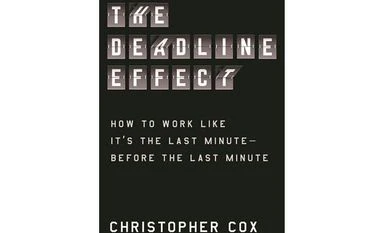
Brooklyn-based writer, editor, and journalist, Christopher Cox, who has written extensively on politics, business, and science, presents surprising findings in his book The Deadline Effect: How to Work Like It’s the Last Minute — Before the Last Minute that’ll convince you to act well before a deadline.
According to Mr Cox, “as soon as you set a deadline, work tends to get delayed until right before time expires”. He calls this a “deadline effect”.
Mr Cox begins the book with an anecdote. In 2006, a US Census worker Elizabeth Martin was faced with a challenge: To get more people to fill out the census survey.
The US government would save $75 million with every “percentage-point increase in the number of households responding”. But what could be done to achieve maximum responses as neither a warning nor a change in the design of the survey helped? All, at best, had a “modest effect”.
As an experiment, Ms Martin “tried something simpler”. She gave people “less time to respond”. In her experiment, the group of respondents with a deadline a week earlier than the actual one had a higher response rate, by 2 percentage points.
This result wasn’t a one-off case. While researching for this book, Mr Cox studied nine organisations across multiple industries that witnessed such results. He presents seven such stories, each rendering a strategy that can help you master the deadline effect.
In the first chapter, Mr Cox discusses the opening of Jean-Georges restaurants, concluding how vital it is to create checkpoints—“interim deadlines”—to accomplish a larger goal within an unbelievably tight deadline. Then he goes on to describe how Easter lilies growers plan “right to left”, a “demonstration of deadline mastery unlike any other in the agricultural world”.
Mr Cox supplies the term “planning fallacy”, first coined by Amos Tversky and Daniel Kahneman in their 1977 paper, to explain why such planning can do wonders for you.
He writes that we have a “tendency to seize upon the most optimistic timetable for completing a project and ignore any information that might make you revise that prediction”. We treat everything as if “it’s a novel problem. We can only see from left to right: we construct a story about how we will complete our work”, ignoring learnings from the past.
But not all stories in the book are traditional success stories. John Delaney’s failed presidential campaign is an example. While Mr Cox ties this story to the book’s theme, his explanation of the failure of a candidate only via the lens of the deadline is far too reductive. There are multiple factors at play during an election, which he ignores.
Not only this, even a tangential discussion on the impact of man-made activities on the environment was worth exploring in the chapter titled “A Soft Open with Teeth: Telluride Ski Mountain”.
In this chapter, Mr Cox discusses how Bill Jensen, the CEO of Telluride, “plans to spend $15 million on [artificial] snowmaking over the next ten years”. As Telluride had failed to open before Thanksgiving two years in a row previously, this time Jensen wanted to do things differently. Though he was creating an impression of making the deadline a “make-or-break event” for his team, in reality, it was “a soft open posing as a hard deadline”.
A chapter that celebrates Scaled Robotics founders Stuart Maggs and Bharath Sankaran, who won TechCrunch’s Startup Battlefield 2019 held in Berlin, is also a remarkable example of “revision based on feedback”, which academics call “effective updating” to meet the ultimate deadline. And in the final chapter, he shares how the squadrons of the US air force are always on alert — an example of constantly feeling the deadline effect, “even when the deadline itself has disappeared”, because everything is urgent.
Though these are great stories, one remains sceptical because such strategies if implemented indiscriminately in everyday work may disrupt how a project is executed. Also, the immediacy required in defence and disaster management services cannot be compared to a generic organisation’s deliverables. I wonder how it would pan out for employees if their leaders want everything to be delivered “Now!” How would they assess what’s important and what’s urgent? Wouldn’t it mess with prioritisation of tasks in general? Perhaps Mr Cox may want to address them with specific frameworks in his next book.

 "Dealing with deadlines")












 Connect with us on WhatsApp