When Justice D Hariparanthaman and two senior advocates went to the Tamil Nadu Cricket Association Club (TNCA) earlier this week for a book release function, they found themselves stopped in their tracks. The judge was wearing a veshti, an attire entirely acceptable across the state but not at the club. Its archaic rules required all club visitors to be dressed in the stipulated attire, and a veshti certainly did not qualify. There were unruly scenes in the Tamil Nadu Assembly over the issue. Chief Minister J Jayalalithaa, describing the club's rules as "sartorial despotism", assured the legislators that a law will be enacted to ensure the state's attire will not be barred at clubs.
The incident has once again put the insistence on outdated requirements in clubs across India under scrutiny. Such rules may have been in consonance with imperial attitudes during the British days but appear anachronistic in democratic times. Clubs consider their dress codes as a reflection of their elite standing and exclusivity, not realising perhaps that people by now have adopted less stratified social norms.
DELHI Neighbouring 7 Race Course Road, the prime minister's residence, is Delhi Gymkhana Club. Once called the 'Imperial Delhi Gymkhana Club', it did away with the word 'Imperial' after India became independent, but the colonial hangover remains, particularly when it comes to the dress code. The list of "attire not permitted" inside the main building includes collarless T-shirts and shirts, slippers, Kolhapuri
chappals, loafers, sandals without a back strap for men, sports shoes, caps and hats, mini-skirts, tight skirts, gowns,
kaftan, shorts and ripped jeans.
Concessions are made for no one. Last year in March, for example, a member invited Bhutan's second-highest ranking Buddhist monk, Tsugla Lopen Samten Dorji, to dine at the club. The monk arrived in his traditional robes and sandals. He wasn't allowed to enter, much to the embarrassment and indignation of the member who had invited him.
Separate areas are earmarked for the domestic help of members, who are not allowed to enter the main building. Membership here is clearly a certificate of status, and understandably, the waiting period for membership is 20 years for government servants and over 30 years for others.
Stringent rules are in order also at the 220-acre Delhi Golf Club on Zakir Hussain Marg. The waiting period here is 30 years. As for the dress code, shorts, blue denims, jogging suits, short skirts and hats are prohibited in the main bar, dining room, card rooms and party room. Caps, if worn, should have a peak in front. The clause is: "Casual attire is acceptable, provided it does not offend the sensibilities of other members present." National dress, like the
veshti is, however, allowed.
Chelmsford Club on Raisina Road is more relaxed. The staff tells you that there are "no restrictions for women" but men have to be careful about what they wear. "Their
kurtas should ideally have collars and buttons. As for
dhotis, those are permitted only for those from South India. If others wear them, it is a bit of a problem," says a worker.
CHENNAI A handsome white building overlooking the Adyar river, the Madras Club is like an oasis in restive Chennai. One of the oldest clubs in India, the 182-year-old Madras Club was set up as a European men's-only club. It did not enroll Indians as members till after Independence, and women were allowed in only in 1963. As of now, membership to the club is closed.
The road leading to the Boat Club in Chennai
The club is inflexible when it comes to the dress code, eligibility for membership, usage of facilities and restrictions on the usage of mobile phones on the premises. Of course, in recent years, it has relented on a few rules. The dress code, for instance, does not apply at the pool-side restaurant.
"It's true the rules are very old fashioned, but it is completely worth it," says a member. In many ways, it is this that makes the club attractive to those searching for exclusivity. As another member discloses, it takes up to a year of screening - including informal and formal interviews - to get even a temporary membership. The Madras Club has only around 350 voting members and a few hundred temporary members, include businessmen, advocates, doctors, former bureaucrats, diplomats and others.
Close to the club is another elite meeting place, the Boat Club with its private access to the Adyar river. It still sticks to laws framed by its British founders in 1867, quite unlike the Presidency Club, founded in 1929, which now allows members to enter wearing a national dress, including the
dhoti. However, coloured
lungis, coloured
dhotis, shorts (except at tennis court, swimming pool and sports complex) and flip-flops are banned at Presidency Club, which charges about Rs 7 lakh as resident membership fee.
KOLKATA Kolkata clubs are reputed for throwing out people on account of "impropah" attire. These include painters M F Husain and Shuvaprasanna, and music composer and choreographer Ananda Shankar. The barefooted Husain was shown the door, while Shuvaprasanna was told his
kurta-pyjamas, as opposed to a
kurta-churidar, did not meet the norms.
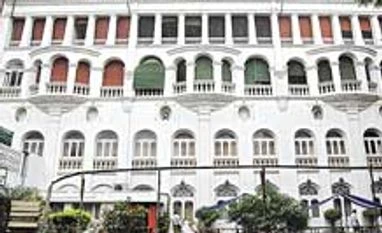
The Bengal Club in Kolkata
"It's an institution that has its own guidelines and regulations," says Calcutta Club president Kunal Roy Chowdhury of the dress code at his establishment. But here, the
dhoti, which has caused a furore in Chennai, is an acceptable club attire. The Nehru dress also is legitimate, but collarless T-shirts and shirts are not allowed. Neither are flip-flops and sneakers in the main building (though okay for the sports areas). In winter, a dinner jacket and a tie are an absolute must for the dining room.
The Bengal Club is the other pillar of Kolkata's culture. Founded in 1827, by a group of East India Company officials, it is one of the oldest social clubs in the country. The city's who's who are members of the club. It follows a similar dress regime for its main rooms, though the Sports Bar, added three years ago, is accepting of more relaxed wear. There are many other clubs that retain the old rules. But most people bear them, even covet them, for the status they bestow on members.

 "Dress dictators")


 Connect with us on WhatsApp