It has been over 11 years since Lehman Brothers, one of the largest investment banks on Wall Street, filed for bankruptcy and practically threatened to pull down the entire global financial system. Though the damage was contained with active policy intervention, economic recovery remained feeble, and the subdued economic performance is now shaping politics in many countries. But the global economy is losing momentum again. The European Central Bank, for example, is restarting its asset purchase programme just months after it stopped the last installment of quantitative easing, and US President Donald Trump is putting enormous pressure on the Federal Reserve to aggressively cut interest rates. To be sure, the world did not reach this point suddenly. The Economists' Hour: How the False Prophets of Free Markets Fractured Our Society by Binyamin Appelbaum, an editorial writer at The New York Times, examines four decades between 1969 and 2008 when economists played an important role in shaping public policy in the US, though the ideas flowed to the other parts of the world as well, and how things went out of hand.
Earlier economists didn’t command the kind of influence they did in recent decades. William McChesney Martin who was the chairman of the Federal Reserve from 1951 to 1970 told a visitor that the central bank has 50 econometricians and they are located in the building’s basement for a reason. He then explained that they are in the building because they ask good questions. But they are in the basement because “they don’t know their own limitations, and they have a far greater sense of confidence in their analyses than I have found to be warranted.” But this thinking didn’t last long. Economists gained influence in the following decades and, arguably, became the masters of the universe. As Mr Appelbaum shows, among other things, economists convinced the US President to end military conscription, they persuaded the judiciary to largely abandon the enforcement of laws related to antitrust, and managed to put a dollar value to human life.
While the book talks about a number of economists and how they influenced policymaking, the narrative often comes back to Milton Friedman, who, undoubtedly, was the most influential economist of his time. Friedman, a Nobel laureate, essentially propagated the idea that the free market was the best system for governance. Friedman famously said that if you put the federal government in charge of the Sahara Desert, there will be a shortage of sand in five years. While economists are not a homogenous group, there was near consensus on broad issues in the period under review. As a 1979 survey of members of the American Economic Association showed, well over 90 per cent opposed rent controls and tariffs, and favoured floating exchange rates.
Mr Appelbaum argues that the market revolution went too far, and the book is a “story of what happened when nations decided to take both hands off the wheel.” The growth in the US, for instance, slowed in successive decades, adjusted for inflation and population. The book shows how Chile’s economy suffered under the influence of “Chicago Boys” while Taiwan, which took American aid money but resisted its economic ideas prospered. While some of the steps that Taiwan took helped, all economies perhaps cannot grow by pushing exports with the help of an undervalued currency at the same time.
Although the broader narrative is well-known and a lot has been written on the subject, at least over the last decade, The Economists’ Hour recounts how policies shifted in the US and elsewhere with plenty of interesting stories. After the financial crisis, in a widely read essay in The New York Times, Paul Krugman, for instance, underscored the basic issue: “Economics, as a field, got in trouble because economists were seduced by the vision of a perfect, frictionless market system. If the profession is to redeem itself, it will have to reconcile itself to a less alluring vision — that of a market economy that has many virtues but that is also shot through with flaws and frictions.”

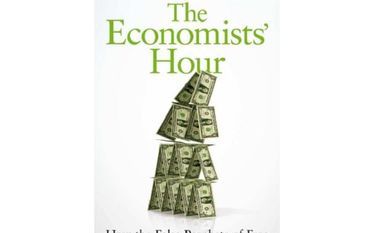 "Economists: Masters of the universe")












 Connect with us on WhatsApp