WOODSMOKE AND LEAFCUPS Autobiographical footnotes to the anthropology of the Durwa Author: Madhu Ramnath
Publisher: Harper Litmus
Pages: 294
Price: Rs 399
The recent attack on Adivasi activist Soni Sori has refocused the attention of the nation, reeling from a violent debate on nationalism, on Dantewada, the troubled heart of the country. Describing the tilted peninsular plateau in central India, home to a number of Adivasi tribes, Arundhati Roy wrote: "There are many ways to describe Dantewada... It's a border town smack in the heart of India. It's the epicentre of a war." For decades, the Indian state has been engaged in a war with those resisting the industrial intrusion it has assisted in these hills and forests, compromising the traditional lifestyle of the many communities that call it home.
Anthropologist Madhu Ramnath spent 30 years of his life among the Durwa people in the Bastar district of Chhattisgarh, and this book is an autobiographical and anecdotal memoir of those years. Ramnath describes how he chose the place in the preface to his book: "One summer about thirty years ago, I spread a map of India on the floor of my room... A large swathe of the country in central India was conspicuous for the paucity of roads... Delighted with this discovery, I decided to go."
What he found there, seduced him. "Bastar remained outside the country I knew... the scent of sal hinting at something more refreshing than the goals to which India aspired."
This description reminded me of Satyajit Ray's last - and not very well made - film,
Aguntuk (1991). Its protagonist, Manomahon Mitra (played by Utpal Dutt), also an anthropologist like Ramnath, leaves home and a career in art as a young man after seeing the famous Altamira bison and realising that he would never have the spontaneity of the cave painter. He returns home to Calcutta (as Kolkata was then known) after living for decades in the American First Nations, and completely rejects urban civilisation and society in favour of its tribal alternative. (The conflict between the urban and the tribal is a running theme in Ray's films, starting with
Aranyer Din Ratri, 1970). Ramnath, too, is fonder of the life in the village of the Durwa than the urban India where he was born, but his love is not an uncritical one.
The book begins with the description of a hunt, which is so essential to the Adivasi lifestyle. Ramnath, who claims to have maintained this lifestyle, remembers taking part in these hunts and recollects in some detail the rituals surrounding them. One of these fascinating descriptions is about hunting porcupine: "There are boys gifted with sufficient audacity that they will crawl on their stomachs into the long, narrow porcupine burrows armed only with a torch... The animal is forced to walk over [the boy's] back in the confined space and, once out of the burrow, knocked soundly on the head by his companion."
Two young Durwa girls
Hunting, however, brings the Durwa into conflict with the state, especially the forest department, as they fall foul of laws enacted to protect wildlife. Ramnath describes one such event when two young men, Devu and Samdu, trapped a barking deer that had strayed into the village. The two accused are arrested, and later, sent to jail. The case drags on, as the lawyers keep bleeding their family of money. Finally, the villagers ask Ramnath to write a letter on their behalf and take it to the chief of the forest department, and declare: "[we] would hunt as long as [we] lived, because it was [our] custom." But all attempts to explain to the bureaucrat proves to be frustrating, revealing yet again the chasm between the modern nation state and ancient societies.
This paper reported last week how the Chhattisgarh government had cancelled tribal community land rights, under the Forest Rights Act, to facilitate coal mining from two blocks allocated to a government-owned power company in Rajasthan and a multinational. As the exploitation of the heart of India intensifies, more and more traditional dwellers will lose their way of life, and would be forced to migrate to cities, their unique languages, cultures and customs becoming extinct forever. Ramnath records these painstakingly in his book - his language is lucid, unforced, much like the spontaneous songs that one may sing after drinking a little
mel or
mahua, the famous indigenous liquor.
One festival that Ramnath singles out for special mention is Welkel, a sort of fertility ritual: "...the mood of Welkel... when one rolls about in the slush. Nobody bathes, turbans are forbidden, long hair is left uncombed and one sits on the ground, not on a stool or a mat." The carnivalesque sexual liberties permitted during the festival, described in the book, throw light on the liberal society of the tribe, unencumbered by the norms of a more material, utilitarian existence.
But, all carnivals, laughter and fun are now at a premium, as Ramnath writes in the final chapter of the book, "Uniforms and a Reign of Fear": "...the Adivasi in Bastar is caught between two opposing forces... Both the Naxals and the police use the Adivasi to fight their battles." Ramnath writes about four young men from his village, who were picked up by the paramilitary forces and thrown into prison on suspicion of being sympathisers of the Naxals.
Subjected to torture in custody, which is only too common, and the sub-human life of prison, to say nothing of the befuddling nature of the India legal system, the young men almost cease to be Adivasis by the time they are let off. "It took a few weeks for... them to orient themselves and to be able to wander into the forest as before and taste the sweet waters of the stream."
The book, however, ends on a positive note - with the description of another hunt. And, perhaps the message is that the mel-induced laughter, singing and dancing will continue long after the belligerent forces have withdrawn.

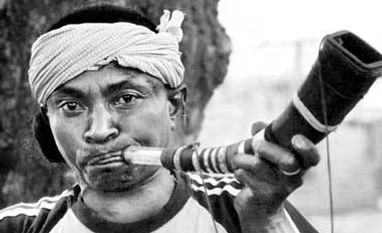 "'Enemies' of the state?")


 Connect with us on WhatsApp