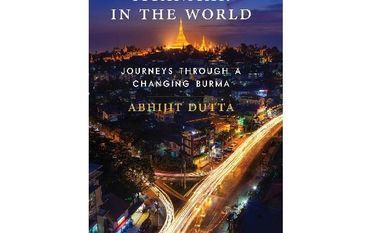
Myanmar in the World: Journeys Through a Changing Burma
In Abhijit Dutta’s book, Myanmar in the World: Journeys Through A Changing Burma, I was expecting a travelogue. The author tells his tale through journeys he has undertaken both into the Myanmar heartland and to its ethnic peripheries, but this book is a dense tapestry that draws upon the country’s history, its complex geography and its changing present. It offers a nuanced, if somewhat impressionistic, perspective on the country and its people. Having lived in Myanmar, I found familiar echoes in descriptions of major cities, monuments and the unhurried pulse of daily life. The 300-odd pages are packed with empathetic observation and deep insights, which only underscore how little one knows about one of India’s closest neighbours that once was part of the British colonial Indian empire.
The same racially tinged hostility is apparent in the more recent Rohingya crisis, with Muslim Bengali-speaking communities in the Rakhine state being driven out in their tens of thousands in a barely disguised bout of violent ethnic cleansing. Mr Dutta has analysed this in detail in Chapter 3, In Rakhine State, providing a much-needed historical perspective and a revealing survey of popular sentiments among the majority Buddhist population in the state. As he points out, the latest exodus is only the most recent in a series of such involuntary migrations. Racial and religious animosities run very deep, and there are no easy answers to the humanitarian dilemma that they throw up.
Chapter 4, Burma By Any Other Name, provides an informative narrative on Myanmar’s continuing challenge of accommodating its various ethnic groups into the national mainstream. During the Myanmar Army’s direct rule over the country, ceasefire agreements had been concluded with several of the major armed groups. They had been allowed to keep their armed forces and were granted considerable autonomy, particularly in economic matters. Some were and continue to be involved in the drug trade and those ranged along the border with China also enjoy tacit support and protection from Chinese authorities. With the advent of constitutional government, flawed as it may be, there have been efforts to bring these groups and the territories controlled by them into the union. But it has been difficult to take back the considerable local autonomy to which they have become accustomed over the past nearly three decades. There has been a relapse into military confrontation between the Myanmar Army and some of the armed groups. The Chinese continue to use some of these groups to maintain a constant pressure on the Myanmar government. It appears unlikely that there would be an early solution to this problem.
The final chapter on “The Green Borderlands” describes the dominating role that China has come to play in the country through its various infrastructure projects and by promoting large-scale trade through several border trade points. In the Rakhine state, which has also been a focus for Indian economic cooperation projects, the Chinese have already put in place an oil and gas pipeline from the deep-water port of Kyaukpyu to Kunming in the southern Chinese state of Yunnan. This carries not only gas produced along the Rakhine coast but also oil and gas that may be shipped from the Gulf, bypassing the narrow Malacca Straits, which may be easily interdicted. Kyaukpyu is also being developed as a Special Economic Zone, where Chinese companies will be investing. India’s own efforts to rebuild the Sittwe Port further south and link it with Mizoram, though river transport and a highway are still not complete, pale in comparison to what the Chinese are putting in place in Kyaukpyu.
The Epilogue offers a critique of Aung San Suu Kyi’s (ASSK) leadership of the Myanmar government as State Councillor, constrained as she is by the Myanmar Army continuing to hold the key levers of power. In the author’s view, she has done remarkably well in playing a complex political game, making compromises but seeking to uphold.
principle. She has obviously disappointed those who made her into an iconic and idealistic figure, but she herself has not seen herself in that role. Mr Dutta sees Myanmar’s future at this time of transition as being intimately linked with the personal and political fate of ASSK. Political regression remains round the corner. The longer she weilds power, limited as it may be, the better the chances for the country and its people to finally take their rightful place in the world.

 "From Burma to Myanmar")












 Connect with us on WhatsApp