Alan Flusser, the American designer whose books included
Making the Man, Style and the Man and Dressing the Man, would have loved the sartorial sub-text of Mushirul Hasan's tribute to Mohandas Karamchand Gandhi.
Hasan may not have intended to link the anecdotes about silk,
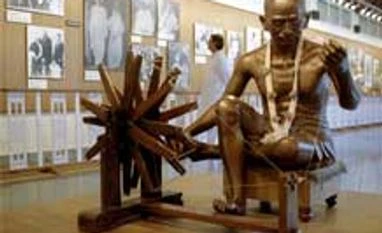
khadi, coats, caps and turbans or wring solemn lessons from how people dress. But he quotes Rousseau saying clothes makes the man if the man makes his clothes a sign of his internal condition. Apparently, Rousseau advised Polish patriots to reject French fashion and revive their own peasant garb. Gandhi's journey from a London barrister's silk hat and morning coat to the Mahatma's loin cloth that the book traces signified a wider sartorial and social revolution. The contrast with Mohammad Ali Jinnah's Saville Row suits highlighted the difference between mass and elitist politics, or between Bharat and India in today's terminology.
Hasan realised that Gandhi's attire didn't appeal to Muslims. That can't have bothered the astute strategist whom Jinnah tried to belittle as "one of the greatest men produced by the Hindu community". India had many more Hindus than Muslims and Hindus made a fetish of simplicity. Gandhi's riposte to another put-down (Churchill's) was that "he'd love to be a naked
faqir." There's dividend in nudity!
Of course, too much can be read into attire. I am not sure Shaukat Ali became more patriotic by exchanging his dress suit for "a loose, long green coat of peculiar cut" and growing a shaggy beard. But, like most politicians, he thought he did. Dressing for a part is easier than living it.
The sartorial confusion that flourished in the absence of any pan-Indian dress encouraged posturing as well as questions about Indian nationhood. J B S Haldane dismissed Jawaharlal Nehru's
achkan-churidar solution (which Hasan extols) for being as foreign as the "formal cutaway coat of English broadcloth and grey striped trousers, with a stiff shirt, high collar, and satin tie" Motilal loved. Nehru's grandfather's Mughal court attire and curved sword also cannily acknowledged the source of power.
The Nehrus jibbed at limiting Congress membership to only those who spun their own yarn. Gandhi claimed
khadi symbolised "the very overthrow of the satanic civilization" and yearned to emulate Caliph Umar ibn-al-Khattab whose lieutenants discarded muslin and velvet. But Krishna Hutheesingh thought a khadi sari "a coarse, shapeless thing that felt like sackcloth." Indian students in England in the 1950s remember her chiffon-draped sister, Vijayalakshmi Pandit, clutching an elegant designer bag and declaring without batting an eyelid that she used only desi. Their niece was being deliberately disingenuous when she told Natwar Singh that a thick skin matters more in politics than
kurta-pyjama ensembles.
Indian politicians are as meticulous about their clothes as 18th Century English Whig and Tory hostesses who wore patches on different cheeks. The famous cartoon of J M Sengupta swilling whisky in evening dress while a bearer held out the obligatory khadi dhoti and kurta above the caption "
Meeting ka kapra lao!" said it all. Motilal saw no inconsistency between "two pegs before dinner" and "a
khadi topi", presumably a Gandhi cap.
Men wore their loyalties on their heads. Hasan describes Gandhi's various turbans. Muslim League ridicule forced Zakir Hussain "to change his cap". Badshah Khan was reviled for abandoning his turban. The Ali brothers sported "grey astrakhan caps" with Turkish symbols. Fenner Brockway, the Labour politician who sturdily supported Indian independence, caused a sensation by donning a Gandhi cap in Britain's House of Commons.
One turns with relief to Sarojini Naidu's unabashed "beautiful clothes and jewels" unlike the barefoot Madeleine Slade in "a calico skirt and shirt, with a sleeveless hand-woven vest."
Hasan naturally includes Gandhi's encounter with George V of which there are several versions. He says the king initially demanded "orthodox attire". According to an obviously apocryphal account, when asked if he would meet His Majesty in a scanty
dhoti, the Mahatma replied, "I'll take even that off if he refuses swaraj!"
Such irreverent frivolity recalls the old rhyme:
"Hitler with his Brown Shirts,
riding for a fall,
Mussolini with his Black Shirts,
back against the wall,
De Valera and his Green Shirts
caring not at all,
Three Cheers for Mahatma Gandhi
with no Shirt at all." All this is so nicely woven into what Hasan somewhat immodestly calls his "grand account of India's modern history" that it's a pity the writing and research are sometimes so sloppy. Curzon did not build Kolkata's Raj Bhavan: it was built 96 years before his viceroyalty. "Sufferance" isn't the same as suffering. Abdars pour drinks rather than polish silver. And what does one make of this nonsense: "When push came to shove,
bhadralok Hindus preferred to carve out Bengal rather than to accept the indignity of being ruled by the Hindus?"
We also miss a coherent and convincing explanation for spinning. So many of Hasan's views reflect his sources (sometimes at third hand) that one can't tell whether he agrees with Mohamed Ali that yarn cones were the bullets with which India would win swaraj.
Does anything remain of the Gandhism that Gandhi himself said didn't exist? The poignant tale of Khwaja Ahmad Abbas's fervently Gandhian grandmother who finished weaving her own shroud the day before she died may be relevant. Her entire family migrated to Pakistan but when Abbas visited Panipat where she was buried, he found her grave had been ploughed over. That doesn't shake Hasan's faith in Gandhi's abiding legacy. But more objective Indians may see only the cinematic glitter of Munnabhai's
Gandhigiri and the current argument over Aam Admi activists courting publicity by demonstrating for women's rights in Gandhi caps.
FAITH AND FREEDOM: GANDHI IN HISTORY Author: Mushirul Hasan
Publisher: Niyogi Books
Pages: 555
Price: Rs 450

 "Gandhi's legacy")


 Connect with us on WhatsApp