Know the air purifier you buy
Reports indicate that since 2012-13, the sale of air purifiers, which promise to clean up in the air in homes and offices, has more than doubled
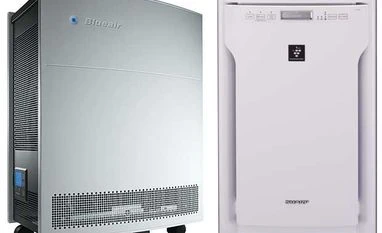
Veenu Sandhu With pollution levels in several Indian cities touching alarming levels, a number of people are investing in air purifiers. Reports indicate that since 2012-13, the sale of these gadgets, which promise to clean up in the air in homes and offices, has more than doubled. The consumer is spoilt for choice with air purifiers from several brands - BlueAir, Sharp, Panasonic, Eureka Forbes, Philips, Honeywell and others - available in the market. They can cost anything between Rs 3,000 and Rs 95,000 or more. But before rushing out to buy one, it is important to understand how these gadgets work and the technologies to look for and the ones to avoid.
There are different kinds of air purifiers depending on the technology they employ to clean up the air. First up are those that remove particulate matter and allergens by using a filter. "A combination of a good HEPA (high efficiency particulate air) filter and a sound carbon filter is crucial for an efficient air purifier," says Barun Aggarwal, the director of BreatheEasy, a Delhi-based clean-air consultancy firm. Certain brands such as Sharp, BlueAir and larger models of Philips score on this front.
However, a lot of machines do not come with pre-filters that are necessary, or are at least recommended, given Indian conditions where the air has large particulate matter and heavy pollutants. Pre-filters suck in and filter out larger particles that could otherwise choke the HEPA filter. If the HEPA filter gets choked, you will need to change it sooner than later and that can be a costly affair because these filters are expensive.
Then there are the ionising purifiers, which create charged molecules called ions. Most molecules in the air have neutral charge, which means they have the same number of positive and negative electrons. When these molecules pass through the ionising purifier, they either pick up or drop an additional electron, thus giving the molecule a negative or positive charge. Once charged, the particle is drawn to anything that has the opposite charge (remember the law of physics that says opposites attract?). Two metal plates in the air purifier - one charged positive and the other negative - attract these particles.
Also available in the market are ozone generators that change the molecules of oxygen (O2) into ozone (O3). Ozone, it is claimed, removes odours and infection-causing elements from the air.
Yet another technology uses the ultraviolet (UV) radiation to clean up the air. The UV light targets airborne viruses and bacteria. Then there are air purifiers that work on nanotechnology, which is said to remove, besides nitrogen oxide and sulphur oxide, the harmful volatile organic compounds that add to smog and ozone levels. Panasonic air purifiers employ nanotechnology.
It's a confusing choice, no doubt. So ideally consult an expert before buying an air purifier. By and large, what you should focus on is: the quality of the filter, the speed of the fan, clean air delivery rate and the noise the machine generates.
"Almost every brand gives the machine's efficiency data based on running them at high speed, which is a big flaw because at high speed, some machines are very noisy," says Aggarwal. For example, the company's claim could be that a particular model works well for, say, a 300-sq-ft room. "But you will find that it is effective in a room this size only when you run it at high speed," says Aggarwal.
Air pollutants can be broadly classified into three categorise: particulate pollution; gaseous pollution (nitrogen oxide and sulphur oxide); and microbiological pollutants (bacteria and viruses). The first two are harmful, even in small quantities. "The HEPA and carbon filters combined are effective for these," says Aggarwal.
He, however, urges caution when going in for air purifiers that target viruses (like the negative ionisers) and bacteria (UV light). "With these you will be creating a sterile environment in your room. With time, your immunity is bound to come down."
So, research, consult an expert or read up on some good websites and only then zero in on the air purifier most suited for your needs.

 "Know the air purifier you buy")


 Connect with us on WhatsApp