Improbable lessons for today from a propagandist film of a century ago

The restoration itself is a reminder of the magic of colours and countries coming together
weekend
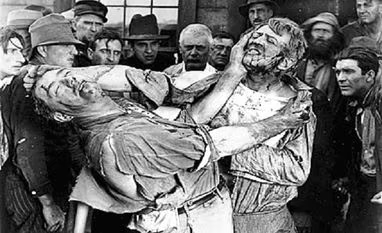
A still from Irvin Willat’s silent Behind the Door
Ranjita Ganesan
4 min read Last Updated : Dec 20 2019 | 11:02 PM IST
What can we possibly learn from a propagandist film made in 1919, after World War I, by a white American Southerner? The kind who had a Confederate flag jammed in the barrel of a rifle at his doorstep? For years after it released, Irvin Willat’s silent Behind the Door had the reputation of being a film that shocked because of the brutal fashion in which an enemy officer was depicted meeting his end. “A climax of terrific power which is so horrible that it may sicken,” one review said. 

In its recent second run, following a laborious restoration in 2017, the film’s post-war patriotic edges have worn away and instead it holds a mirror to our troubled historical moment. The tale of its tragic hero Captain Krug (Hobart Bosworth), taken from a short story by Gouverneur Morris, becomes cautionary rather than one worthy of emulation. We find him old and forlorn in the opening as he returns to a ramshackle home in rural Maine where the sight of a dirty handkerchief — “her handkerchief” — turns him into a tearful heap. 

Flashbacks show Krug in happier times as a retired soldier running a taxidermy shop, stuffing and stitching things back together. He is deeply in love with Alice (Jane Novak) but her father Matthew Morse, a wealthy banker, disapproves. So when news arrives of America joining the war, the banker uses it to fuel suspicions over Krug’s German ancestry. Spontaneous nationalism, intolerance and moral panic lead to a gory confrontation, which is more unsettling as a sequence than that much-touted climax.

Townsmen who didn’t think twice about sending weepy toddlers with damaged toys to Krug so he could fix them now stood outside his shop with balled-up fists. Suddenly he is a German “Hun”. He appeals to them that he, and his father before him, had served the nation. The mob does not care. But didn’t his mother come from Germany, they spit. This stirs Krug’s own patriotism and he announces he will fight anyone who challenges his Americanness before enlisting to fight the Germans. It is only after Krug overpowers the mob with raging-bull force that the townsmen admit defeat and accept him. 

Who belongs and who doesn’t, and who gets to decide on matters of inclusion? In such arbitrary othering, the burden always falls on the “foreigner” to prove one’s allegiance to the state or wear gratitude to the nation on one’s sleeve. Krug, sadly, gives in to this and continues the cycle of violence. He marries Alice and sails away for the war. He and Alice, who joins the ship’s nursing unit, survive an attack by a German submarine but she is taken prisoner and he is left in the waters. The two never meet again.

Krug is back to leading a ship months later and, as circumstances will comfortably have it, his crew overpowers the same enemy submarine and takes its commander Brandt (a leering Wallace Beery) prisoner. Tellingly, the cloud of suspicion never really leaves Krug. When he decides to question Brandt behind closed doors (thus the film’s title), his crew still wonders whether the ancestry he shares with the German will test his loyalty to America. 

After coaxing out in great detail (gratuitous detail even on the part of the filmmaker) the truth about Alice’s final days on the submarine, Krug is maddened into performing a gruesome revenge. The good German (the “American” German) eliminates the evil one. Ultimately, though, as he cries out helplessly, “it doesn’t bring her back.” Nothing is fair in love and war. In a tolerant world, he might have continued to spruce up toys and Alice might have run a chain of successful dispensaries.

Willat, a cinematographer-turned-director, shows his flair with the camera in intertitles that are superimposed on sweeping hills and high waters. The film was screened recently in Hyderabad during an annual workshop by the Film Heritage Foundation. Its restorers, the San Francisco Silent Film Festival, put Willat’s original tints of red, yellow and green back in the frames. They also used shots from a Russian copy of the film wherever American reels were lost. The restoration itself is a reminder of the magic of colours and countries coming together.
ranjita.ganesan@bsmail.in

One subscription. Two world-class reads.

Already subscribed? Log in

Subscribe to read the full story →
*Subscribe to Business Standard digital and get complimentary access to The New York Times

Smart Quarterly

₹900

3 Months

₹300/Month

SAVE 25%

Smart Essential

₹2,700

1 Year

₹225/Month

SAVE 46%
*Complimentary New York Times access for the 2nd year will be given after 12 months

Super Saver

₹3,900

2 Years

₹162/Month

Subscribe

Renews automatically, cancel anytime

Here’s what’s included in our digital subscription plans

Exclusive premium stories online

  • Over 30 premium stories daily, handpicked by our editors

Complimentary Access to The New York Times

  • News, Games, Cooking, Audio, Wirecutter & The Athletic

Business Standard Epaper

  • Digital replica of our daily newspaper — with options to read, save, and share

Curated Newsletters

  • Insights on markets, finance, politics, tech, and more delivered to your inbox

Market Analysis & Investment Insights

  • In-depth market analysis & insights with access to The Smart Investor

Archives

  • Repository of articles and publications dating back to 1997

Ad-free Reading

  • Uninterrupted reading experience with no advertisements

Seamless Access Across All Devices

  • Access Business Standard across devices — mobile, tablet, or PC, via web or app

Topics :Weekend ReadsFilms

Next Story



