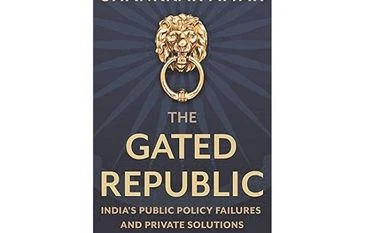
John Kenneth Galbraith spoke of the “secession of the successful” and The Gated Republic focuses on just that but in the Indian context. The book demonstrates with copious examples how private markets take over when the state fails and often do so imperfectly, though omnisciently. Shankkar Aiyar asks, and correctly so, whether the government must raise the following questions, at each step of the way: (a) Do we need to do this? (b) Do we need to run this? (c) Do we need to own this? He argues that the “creative inertia” of both the civil service and politicians prevents them from letting go of power and privileges and that every regime is a hostage to the past.
Mr Aiyar’s analysis of infrastructure failure — power, water, sanitation — are superbly researched and brilliantly argued, perhaps the best in living memory. He argues that about a quarter of the electricity generated and distributed, does the famous Indian rope trick to vanish completely and that loss itself is to the tune of Rs 80,000 crore to Rs 1 trillion per year! He blames the politicians and bureaucracy for it, and rightly so, but forgets that the latter is just a tool of the former and of the Constitution. If the upright ones protest too much and want to collect these vanishing funds, there are non-upright ones in plenty to crawl when asked to bend who take over rapidly.
Mr Aiyar is a brilliant and insightful commentator and has written this book to prod citizens to question their public representatives on policy failures. He has offered a lot of invaluable data and insights but no solution. He forgets that much of the malaise — not all — is on account of the very representatives he wants us to nudge also being one of the biggest causes for the failure of public services. Even in times of Covid-19 it is an open secret that ministers in many states are padding bids and “picking” winners for the supply of reagents, personal protection equipment, masks and so on. Any inconvenient official who chooses to stand up and implement the rule of law is sidelined. Mr Aiyar’s book should have delved equally deeply into why most of our elected representatives — though, again, not all — often practise cash flow management and returns on their electoral investment better than any Harvard MBA can ever do. The policy failures that he has cataloged brilliantly are true and correct and beg the question: Why was our infrastructure-constrained, policy collapsed-adjusted, pre-Covid 19 economic growth rate still between 5 and 8.5 per cent in the preceding decade? (One can always do better but that can be said of anything, anytime and anywhere). Further, what happens when private failures, lead to businesses and citizens who come running to the government and have expectations, reasonable or otherwise, that they will be bailed out — that too, without any checks or balances but via free cash flows? Jet Airways, Kingfisher, several banks, including Yes Bank, etc? Throwing up their hands is an option but is it a politically expedient one? Further, the other questions to ask is, when the stars align, how is it that the same civil servants who author policy failures, succeed supremely when they conduct elections across the most complex circumstances in India, run institutions such as the Comptroller & Auditor General, the Securities & Exchange Board of India, the Reserve Bank of India, and the Indian Space Research Organisation and deliver reasonably well during pandemics, even with their hands tied? Even they may have failed comprehensively as electricity, sanitation and water regulators!
Indeed, there is dysfunction in the state, despite the presence of many brilliant, honest minds trying hard to change things but the systemic weaknesses are so deep that, I dare say, even if the best minds from the corporate sector step in they won’t be able to do significantly better. Many states are in deep financial distress and the Narendra Modi government has been trying hard to stop the financial bleeding through creative work in the power sector, reasonable disinvestment and by coming down hard on corruption at the wholesale level — though, arguably, there is a long road ahead on many of these and other reforms.
The Gated Republic is a must read for every serious student of policy and politics, and Mr Aiyar would do a great service to the nation if he were to write a sequel to answer some of the questions, indeed the curious ironies mentioned in this review that appear to define India.
The reviewer is an IAS officer. Views are personal. @srivatsakrishna
Read this article for free
Register to continue reading premium journalism and analysis from Business Standard.

 "Maximum government, minimum governance")












 Connect with us on WhatsApp