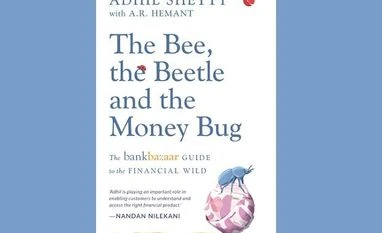
The Bee, the Beetle and the Money Bug: The bankbazaar guide to the Financial Wild
Authors: Adhil Shetty with A R Hemant
Publisher: Rupa Publications
Pages: 303
Price: Rs 395
A double-income couple I know had ploughed the entire retirement corpus of one partner into constructing four flats in a tier II town. In India, rental returns are barely 2.5-3 per cent of capital value. A decade later, the buildings are beginning to fall into disrepair. Maintenance devours a large chunk of their cash flows. And inflation has far outpaced the growth in rentals.
A doctor friend met his financial Waterloo in unit-linked insurance plans (Ulips), which debuted in the early 2000s. They were launched by private insurers who had just started their operations in India. They hawked them as the more transparent alternative to the traditional plans sold by the Life Insurance Corporation (LIC) of India. What became apparent only over time was that many of these plans had very high fees. The friend who invested in seven Ulips in those years exited seven years later with barely the premiums he had put in.
And do you remember the real estate mania of 2003-2008? As prices rose, buyers experienced FOMO (fear of missing out) and ploughed their life’s savings into apartments. Most did not do any due diligence on the builder’s track record of delivery or the state of his finances. In the years that followed, many projects, especially in North India, were inordinately delayed. A friend still has Rs 30 lakh stuck in a project in Noida whose builder has gone bankrupt.
As these instances show, far too many people make a hash of managing their personal finances, including educated and affluent ones. One reason is overconfidence bias. People don’t realise that their skills in their own fields don’t necessarily make them experts at managing money.
The second factor that trips up Indian investors is scams. After thousands lose their money, regulations are tightened. Limits, for instance, have been placed on the fee Ulips can charge. In many states where the Real Estate Regulatory Authority (RERA) is functional, realty is much better governed today than in those upbeat years. But one can never relax one’s vigil against the next big scam that may already be brewing.
In such an environment, finding the right path at the start of one’s financial journey is a challenge. One solution is to get a financial plan prepared by a Sebi-registered investment advisor (RIA). Unlike agents or distributors, these professionals have a fiduciary responsibility to act in their clients’ interests. Alas, many people are reluctant to shell out their fee. Access is another issue: There are only 1,328 RIAs in this nation of 1.4 billion.
The next best option is self-education. Financial experts and ex-editors of personal finance newspapers from time-to-time pen books that attempt to equip readers with the fundamentals. Adhil Shetty’s easy page-turner, co-authored with A R Hemant, is a welcome addition to the rather sparse list of such titles.
American psychologist Abraham Maslow wrote that human beings have a hierarchy of needs. When one level of need is met, a person aspires for the next higher level. Mr Shetty postulates an analogous 5S pyramid for personal finance: Save, secure, savour, strengthen and serenity. The book has been organised into these very five sections.
As for the provenance of the title, Mr Shetty says creatures like the bee, beetle, and bowerbird have useful personal finance lessons to offer. The bee collects nectar industriously (one factoid: 12 bees in their lifetime manage to produce one teaspoonful). Similarly, a person, besides slogging at his nine-to-five job, must squirrel away at least 20 per cent of his take-home salary.
The iron beetle found in the US and Mexico has a shell that allows it to live even if it were run over by a car. To survive life’s many vicissitudes, savers, too, need to build a protective wall around their finances, using insurance covers like term, health, accident-disability, etc.
Then there is the bowerbird, found in Australia, which collects knickknacks to build a beautiful nest and attract a mate. Mr Shetty says we, too, can savour life with products like credit cards, which when used judiciously, offer us interest-free credit and reward points.
Millennial and Generation Z DIY (do-it-yourself) investors will find Mr Shetty’s book useful. It also has a lot to offer the middle-aged professional, who despite years of industry, is frustrated by his inability to move the financial needle. If he were to read this book and implement its lessons, he would stand a good chance of emerging from his financial rut. All the basics are explained here: Setting up an emergency fund, buying the right insurance products, monitoring credit score to get access to the best loan rates, building simple investment portfolios using index funds, saving for retirement, and more.
In these 303 pages, there’s enough distilled wisdom for the reader to get off to the right start, or course-correct, depending on his situation.