4 min read Last Updated : Apr 19 2019 | 9:14 PM IST
If the hundredth birth anniversary of sculptor S Dhanapal last month went mostly unremarked, it was because collectors and art writers in the North continue to remain largely ignorant of contributions made by artists in the South. The region’s lamentably small market has contributed little to Mumbai and New Delhi; as a result its artists have remained neglected and unheralded. The Kochi-Muziris Biennale may have done its bit to address this North-South divide, but it will be a while before the modernists of the South get their due on a national platform on par with their northern peers.
Dhanapal, for those who need an introduction, was an important member of the eponymously named Madras Art Movement that had its genesis under KCS Paniker, who provided a regional grounding to artists associated with the Government Fine Arts College in Chennai in, particularly, the 1950s and ’60s. He also founded, with fellow artists and students, the idealistic Cholamandal Artists’ Village as a commune for artists seeking to take their fortunes in their own hands. The Movement looked within the region for its context, unlike the Bombay Progressives and the Bengal School, locating its practice in local mythologies as well as past methodologies. It is this regional indigenism that gives the Madras Art Movement its structure and rootedness.
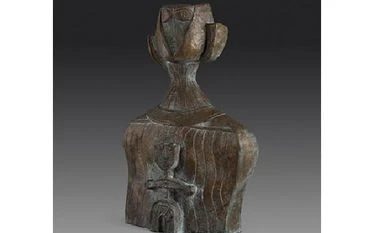
Dhanapal’s Mary and Christ. His interest in sculpture was self-formed and -led
Born in 1919 in what was then Madras, Dhanapal trained in painting at the art school under D P Roy Chowdhury, one of the country’s foremost artist-teachers, but it was Paniker who asked Dhanapal to rejuvenate its sculpture department, appointing him its head in 1957. His interest in sculpture was self-formed and -led, and he experimented across diverse materials, whether bronze, wood, cement or terracotta. Just as he was a painter, sculptor and dancer, he was also a teacher, adding heft to the Movement and bringing potential sculptors into its fold.
For Dhanapal, an important aspect of his practice was the emphasis on composition. Instead of singular representation, his preferred mode was to create recognisable forms that made up an ensemble work. He was as at home working in the round as in a more restrained, minimalist style while carrying off experiments based on tribal or folk imagery. Dhanapal’s apparent simplicity of form, achieved through a reductive language, was his major achievement. Unlike his own teacher, he steered away from the realistic, often opting for two-dimensionality that was based on the temple tradition of the region. In this aspect at least, the sculptors of the Madras Art Movement — including P V Janakiram, S Nandagopal, S G Vidyashankar Stapathy, C Dakshinamoorthy and TRK Mookiah — were different from those in other parts of the country, drawing inspiration from repouse relief work, which provided a level of abstraction as well as minimalism to their work. What critics sometimes objected too, though, was a decorative aspect that accompanied this, which was considered a weakness by some, though it has since been accepted as a significant marker of the Movement.
Dhanapal remained part of the faculty of his alma mater to retire from the position of principal in 1977. A decade earlier, he had been among the early pioneers with Paniker to establish the Cholamandal Artists’ Village. But he found its regulations too stifling and chose to settle in the city instead, where he continued to work and guide youngsters. Already, by then, the heady days of exhibiting overseas — in Germany and England — were behind him. By the time he passed away in 2000, his arc of influence had shrunk, but recent interest in artists from the South has seen his editioned sculptures return to the market via auctions. A renewed discovery awaits his potential collectors.
Kishore Singh is a Delhi-based writer and art critic. These views are personal and do not reflect those of the organisation with which he is associated