What's your most enduring memory of art class in school? Drawing a landscape featuring two mountains with a smiling sun peeking out from behind, a hut with two trees on either side and stream flowing below. The addition of two V-shaped birds completed the image. Isn't it surprising how thousands of students across the country drew the same image, decade after decade, till the monotony of it repulsed many? "Art curriculum in schools is essentially skill-based. But one can't master skill at such an early age and that's why the interest wanes off," says Mumbai-based artist and collector Ritu Khoda. She believes that art is a way of life - a means of learning life skills, rather than just dabbing paint on canvas in a way that looks good. It is with this intention that she launched Art 1st Foundation in 2009 to help students use art to gain life skills.
Creative exploration The idea is to use art across disciplines to develop children into critical thinkers, problem solvers, communicators and also to enliven the learning environment. With the help of artists, art historians, psychologists, children's authors, illustrators, curators and photographers, Khoda created programmes for pre-primary, primary and higher classes. Some of her advisors include art critic Prayag Shukla, CMS Info Systems Vice-chairman Rajiv Kaul, gallerist Reena Lath and artist Sharmila Samant. Today, the foundation is working with private and municipal schools across the country such as the Gundecha Education Academy, The Little Company, Jamnabai Narsee School, Oshiwara BMC School, Irla Masjid BMC School in Mumbai and The Shri Ram School, Shiv Nadar School and The Shri Ram Millennium School in Delhi.
"We ideally work with each school for five years," says Khoda. "The teachers receive 48 hours of training before the sessions start. A review takes place at the end of each month. Top contemporary artists are brought in as mentors." Students from Classes I to V are exposed to 10 sequential plans that provide them opportunities to express ideas and thoughts through art. For the pre-schoolers, the foundation has come up with art labs where the tiny tots, through exposure to colour, mixed media, found object and more, develop a language to communicate their experiences. "For the older students, we have the 'Partner a Master' programme, in which contemporary artists like Anita Dube open up their studios and work closely with them for months altogether," says Khoda. The foundation has also come up with the 'I am an Artist' series in collaboration with Scholastic Books that takes students through the lives, struggles and inspirations of India's leading artists - the first in the series being Raza's Bindu. "The first part of the book deals with childhood anecdotes from the artist's life to inspire the kids. The second part is about his body of work and it is open to the child's interpretation. The third part explores how the child feels about the work," says Khoda.
The other organisation that deals with some amount of art interventions at the school level is Flow Associates, a UK-based body that set up office in Delhi a couple of years ago. It all started when two directors of Flow, Katherine Rose and Eliza Hilton, visited a couple of museums in India and found it disheartening to see the way children were experiencing the spaces. According to a recent interview, the organisation is developing many more art and critical thinking modules for schools.
From ideation to articulation "Students generally assume that art is just about canvas and paints," says Pooja Thakur, principal, The Shri Ram School, Delhi. It is with this mindset that her daughter enrolled for the 'Partner A Master' programme a year-and-a-half ago. But when artist Shambhavi Singh spoke about being influenced by farmers, she began to look at art differently. "Singh brought in topics like agriculture, race, industry. Now my daughter sees art everywhere," smiles Thakur. At her school too, children have responded well to Raza's Bindu. "It's amazing to find six- to seven-year-olds discussing the artist," she says. Usha Lamba, principal of Pathways in Gurgaon, feels that the programme fills a void in the existing art curriculum. "We need to equip students with 21st century skills. We have had the foundation people over for small modules. The other day I was reading out to students from a book with great illustrations and they were able to hold a meaningful discussion about the art content," says Lamba. At Gundecha Education Academy, Khoda reviewed the programme after three years to find that children were more confident in talking about what they had created. "They were free from the pressure to paint within the lines. And when they heard 30 different opinions about the work from their classmates, they began to look at art differently," she says.
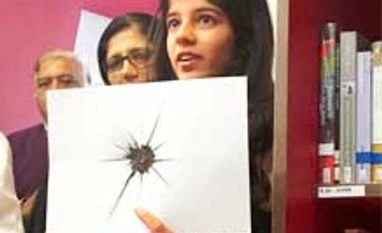
The vision is in sync with the philosophy of most artists - that art is a way of life. "Raza sahab is a great example of this. At 93, he still says that he lives to paint. The book that Art 1st has taken out elaborates on this," says writer Ashok Vajpeyi, one of the trustees of Raza Foundation. The book describes Raza as a wayward boy who had issues with concentration. One day, his teacher asked him to stay back after classes. He drew a dot and asked young Raza to focus on it. "Decades later, when in a mood of self-interrogation, Raza started questioning his art, he remembered his teacher and the dot. That's how the bindu came back into his creative imagination," says Vajpeyi. The Bindu has elicited amazing responses from young students. Recently, during a session at The Shri Ram School, the teacher was about to rub the dot from the board and the children jumped up and hissed "No!" "It's the bindu, our focal point," they said. "Another kid talked about the clarity of the dot," says Khoda, who was present at the session.
The psychology of life skills "When I was in school, my teacher painted a tree and asked us to copy it," reminisces Varkha Chulani, a clinical psychologist & psychotherapist at the Lilavati Hospital, Mumbai. "But, mine had flowers and birds as well. When the teacher came around she asked why hadn't I copied her version." That, in her opinion, is the problem with existing art curriculum in schools. "The system is too rigid. Teach form, give direction, but leave it to the child's imagination to deal with it. It helps push boundaries of the mind to make it more explorative and creative," she says. Vasantha R Patri, chairperson, Indian Institute of Counselling, Delhi, and one of Khoda's advisors, concurs. "There are different types of intelligences - one of which is aesthetic. Children who are not good with auditory learning find visual learning enjoyable. We don't always need to have a script as a way to teach, art can also be used as a language," she says. Both Chulani and Patri believe that art can be used to teach history, language, maths and other disciplines. "Use mixed media to teach geometry, for instance," says Patri, who outlines the life skills that art can equip kids with, when taught correctly
> Creativity: A straight class in chemistry won't make you creative. But, bring art into it and students will develop new ways of doing things
> Confidence: Just give them the resources and say that this is a village scene, interpret it in your own way. Let them choose their own colours and give way to their imagination.
> Problem solving: Say, they encounter some mind block in creating an image. The teacher can just nudge them in the right direction. It will help improve teacher-student communication as well.
> Collaboration: When students share colours and resources, they will learn more about teamwork.
> Accountability: The student alone is accountable for what he or she has created. Only he can answer why he has used a particular colour or a shape. This helps in self-expression.

 "The art of learning")


 Connect with us on WhatsApp