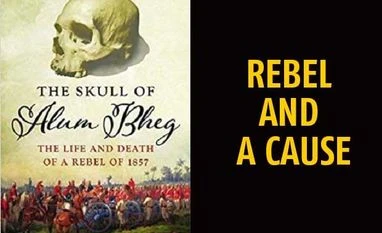
Skulls can speak. Hamlet tells Horatio in the famous Gravedigger Scene (Act V, Scene 1), “That skull had a tongue in it, and could sing once… .’’ Kim Wagner, in this remarkable book, cannot make the skull of Alum Bheg sing but through the only remains of the poor man, he unfolds a chapter of the great 1857 uprising in Sialkot.
The words “poor man’’ in the previous paragraph are used advisedly since Alum Bheg, because he was a rebel, was blown from the mouth of a cannon in 1857. This was a standard mode of punishing rebels that the British practised in 1857. The body of the rebel was blown to smithereens in the air and bits of flesh and bones fell on those who were witnessing the ghastly spectacle. The punishment was always carried out in public, on the parade ground of the cantonment with sepoys arranged in the form of three sides of a square. By blowing rebels from cannons, the British not only meted out punishment but also exhibited their might. When Alum Bheg was executed in this manner, he was 32 years old and his height was five feet and seven-and-a-half inches. He was described as “a principal leader in the mutiny of 1857 and of a most ruffianly disposition”. He was accused of killing more than three firanghis.
The departure point of Wagner’s story is the discovery of the skull of Alum Bheg in a pub in Kent. It had been brought to England by Captain A R Costello, who had been on duty when Alum Bheg had been blown off a cannon. What will remain a mystery is what possessed an English captain to seek out a bleeding skull from the remnants of Alum Bheg’s body and then to preserve it and bring it back to England. The British Empire in India obviously engendered many odd perversities. Significantly, the pub in which the skull was discovered by Wagner is called The Lord Clyde — after Sir Colin Campbell from distant Scotland, who had quelled the uprising in Awadh where the revolt had acquired a popular base.
Wagner reconstructs the story of the rebellion in Sialkot in rich local detail. Two points need to be kept in mind, without taking away from this reconstruction in any way. One, the narrative of the rebellion in Sialkot does not alter in any major way the understanding of the revolt that prevails owing to the researches of a number of historians, including Kim Wagner. Two, how important was Sialkot? It was a trifle remote from the principal theatres of the rebellion — Delhi and the Gangetic plains. It is good to have rich details from the fringes of the uprising, but we need to keep in mind the bigger picture. Wagner makes wonderful use of the discovery of a skull of an executed rebel to tell a story and that is the principal attraction of the book. But if a 21st-century S N Sen or Christopher Hibbert or S B Chaudhuri were to attempt to write a one-volume account of that fateful year would the events of Sialkot, Alum Bheg’s skull notwithstanding, it get more than a passing mention? I seriously doubt it.
In his Epilogue, Wagner makes a case for the skull of Alum Bheg to return home. And he suggests that the site of the Battle of Trimmu Ghat on the island in the river Ravi, which marks the border between India and Pakistan, would be a good place to inter him. This, in my view, is too easy a solution. Where does the skull of Alum Bheg belong? He was executed in the most horrible way possible and an Englishman, who was in however indirect a way implicated in the execution, walked around the site of the execution to claim the skull as his “prize”. The skull should perhaps stay in England to remind “civilised” Englishmen how their forefathers dealt with recalcitrant colonial subjects. Alum Bheg, in his turn, also killed, perhaps innocent people. We should be careful not to valorise his violence in contrast to the ghastliness of his execution. The year 1857 was one of unprecedented blood and violence, in which people on both sides of the racial divide were perpetrators and victims. Raising the issue of repatriation only serves to obliterate the violence.
Let the skull of Alum Bheg sing silently in a pub in Kent.
The Skull Of Alum Bheg: The Life And Death Of A Rebel Of 1857 Author: Kim A Wagner Publisher: Viking Pages: 256 Price: Rs 599
The reviewer is chancellor and professor of history, Ashoka University