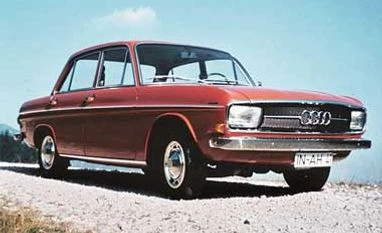
Here's a way to guarantee you stand out: Buy an Audi 100. Not the newer one, the one made in the 1980s. You want the one with the bigger silver Audi rings and fresher body, the one made from 1968 to 1976.
This is the car Audi made secretly at first as a way to claim brand individuality under Volkswagen ownership. (In 1966, Auto Union, an amalgamation of four German automakers that was the immediate predecessor to Audi, became a wholly owned subsidiary of Volkswagenwerk AG. But the carmakers that had been moved to VW headquarters in Ingolstadt were forbidden to develop their own vehicle. Head of Development Ludwig Kraus broke ranks, but early reviews proved so successful VW decided to produce it shortly after its debut.)
The Audi 100 was the first car Audi ever sold in the U.S. It's not expensive. It's not powerful. But it's rare: Of the 1 million collector cars Hagerty insures, only six of them are Audi 100s.
"If you came across one, it would be a very affordable way to have a unique vehicle that you'd likely be the only one to have at your cars-and-coffee meet-up or the local car show," says Jonathan Klinger, the vice president of communications at Hagerty.
If you want to own a vintage model that shows you've put some real thought into your purchase, they're ideal. These are the starting point for all modern Audi cars, the first of the breed. (Bonus points for looking cool.)
The 1970 Audi 100 Coupe S was marketed as a practical, affordable daily driver for the 'individualist'
"It's an appealing choice for the enthusiast interested in a significant, practical, and very rare German car," David Traver Adolphus, the heritage car expert at Hemmings,wrote in the company's annual classic car report. One look at that fresh face, and you'll be sold.
Audi started importing the 100 series for the 1970 model year, even though it had shown and started hyping the car in 1968. The idea was it would help convince American consumers Audi could compete with the other European luxury brands entering the U.S. at the time - namely, BMW and Mercedes.
"The Audi 100 was a car that was developed when the European luxury brands were starting to be more relevant globally," said Mark Dahncke, Audi's general manager of communications. "The big US titans were losing relevance because of the gas crunch and also, honestly, because of their design. The Audi 100 was a step to bring in a European solution: something that was compact but usable, drivable but functional."
The 1971 Audi 100 Coupe S was the first car the modern iteration of Audi ever sold in the US
Audi also used the 100 to show global buyers that the brand had really kicked its old Auto Union identity (Auto Union had became a wholly owned subsidiary of Volkswagenwerk AG in 1966). Kraus, a star designer and engineer who directed many of Mercedes's successful Formula 1 cars, drafted the look.
The coupe-size bodylines and delicate pavilion roof immediately stood out compared with the heavier steel and muscle cars Detroit was making at the time. Even though the four rings on the Audi logo represented the four brands of automobile produced at the time by Auto Union - Horch, Wanderer, Audi, and DKW (aka Der Kliene Wunder, The Small Wonder) - the change was enough to make an impact. Everything in Audi's modern fleet can trace its design back to this car.
"The engineers in Germany were developing cars that were a little bit more forward thinking in terms of efficiency and understanding that you couldn't go down the road in just anything as heavy as you want," Dahncke said. "That's why the Audi 100 got its introduction. And later it influenced everything to the Audi A4. It set the table for all things that came thereafter."
The first 100s were front-wheel drive sedans with 4-cylinder, 112-horsepower engines. They came with a four-speed manual or automatic transmission on a short, sturdy chassis. The police used them often because of their agility and on-road practicality (a two-tone police paint finish, flashing blue light, and siren were applied after the factory).
In later years, the coupe and saloon versions became popular and came with a long list of such standard design features as twin headlights and chrome wheel arches that helped boost its price.
By the last years before its update in 1976, the Audi 100 came in seven different variant and trim levels, plus a coupe and sedan version in the US Audi sold more than 6,500 of them during the first year, which was more than expected, and nearly 800,000 of them globally and 300,000 in the US over the entire model run. Today, fewer than 1,000 roadworthy examples exist in the US, according to Hemmings.
Audi built the 60L as the direct predecessor to the slightly more powerful 100
It means you're going to have a tough time finding one. And you'll probably need a specialist to help connect you with sellers in Europe: Casual searches on EBay motors, Autotrader, and Carsforsale.com typically result in no viable options for sale. They do come to auction from time to time, but inquiries at Gooding & Co and Sotheby's didn't return recent results. Look on Instagram, and you'll see plenty of enthusiasts but little commerce.
They're rare because they were practical: US buyers bought them and drove them into the ground. And since they weren't expensive at the time, it wasn't worth restoring most of them.
"It's the case of a cool car that was used up," Klinger said. "It was a utilitarian vehicle - they were used and then repurposed and then discarded, so you're left with a small sample of what was produced."
© Bloomberg

 "The vintage Audi collectors want, but can't have")

