Depreciating value of the Inidan rupee against the dollar has increased India’s competitiveness in apparel exports to developed countries, thanks to relatively lower decline in currencies of its competitors, including China, Vietnam and Bangladesh.
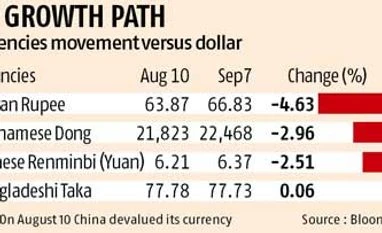
After the Chinese currency, yuan, was first devalued on August 10, the rupee recorded its sharpest depreciation among its competitors. While Indian rupee depreciated 4.63 per cent to 66.83, the yuan (renminbi) fell 2.51 per cent to 6.37 against the dollar as of Monday since August 10.
Among other competing countries, the Vietnamese dong slumped 2.96 per cent to 22,468 against the dollar on Monday from 21,823 on August 10. Bangladesh would not get these advantages, as its currency appreciated by a negligible 0.06 per cent to 77.73 on Monday against the dollar from 77.78 on August 10.
“Indian apparel will be more competitive. The quantum of competitiveness, however, would depend upon relative currency movement of the major apparel exporters such as China, Bangladesh and Vietnam,” said Rahul Mehta, president, Clothing Manufacturers’ Association of India (CMAI). Overseas buyers will immediately start re-negotiating terms of existing contracts. Also, according to industry sources, drafts of new contracts also mention renegotiation clause if the rupee depreciates beyond two-three per cent.
An ICRA study says the depreciation in the rupee would benefit apparel exporters. As the yuan also depreciated and given that China enjoys a dominant position in international export markets, India would see an increased pricing competition, which will affect the profitability of Indian exporters.
“Given that the rupee has depreciated more than that of other competing countries, and India’s share in overall trade is relatively small, we expect the export volumes may not be impacted severely. Fabric exports, on the other hand, are geographically well diversified as against other segments in textile exports. Given the fragmented nature of the fabric industry, the Indian exporters will require to pass on the benefits of depreciated rupee by way of lower dollar price,” said the study.
Domestic cotton exporters would see improved competitiveness, as India is the second largest exporter of the natural fibre after the United States. Nevertheless, as China is the largest market for both cotton and cotton yarn exports from India, the higher devaluation of China’s yuan will require Indian exporters to offer lower dollar prices for these products to maintain competitive prices in yuan terms.
R K Dalmia, the chairman of Cotton Textiles Export Promotion Council (Texprocil), said considering the infrastructural disabilities, cascading effect of un-rebated taxes, high cost of inputs and preferential benefits granted to the competitors, the government should continue giving export benefits to Indian exporters for some more time.
The emergence of mega trade agreements being promoted by the US and the European Union among themselves and among other key trading partners like Korea, Vietnam and Japan pose fresh challenges to countries like India. Therefore, it would be best if India takes an integrated approach rather than an ad-hoc approach while negotiating new FTA or re-negotiating old ones.

 "Falling rupee to benefit Indian apparel, fabric exporters")

