Good times returning for this Kingfisher

New products, rising market share and lesser than anticipated impact of regulations are keeping sentiment firm for United Breweries
United Breweries, beer
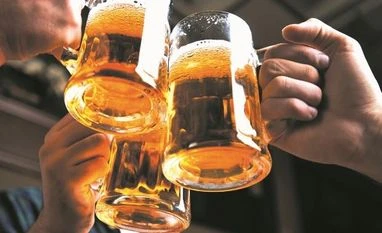
Representative Image
Vishal Chhabria Mumbai
Last Updated : Dec 10 2017 | 10:30 PM IST
United Breweries (UBL), producer of Kingfisher and other popular beer brands, and its shareholders are finally seeing good times again. From the shareholders’ perspective, the recent gains for the stock reverse the declining trend over two years. In the 12 months to mid-October, for instance, the S&P BSE Sensex was up over 20 per cent, whereas the UBL stock was down nearly three per cent. The weak performance was due to flattish sales and declining profit in recent years.

However, since then, the stock has risen about 26 per cent to levels last seen in August 2015, due to UBL’s improving performance. And, if analysts are to be believed, UBL’s prospects should only improve further.

What changed? A decent June quarter (Q1) saw sales, operating and net profit rise by seven to 10 per cent. The surprisingly strong performance for the September quarter (Q2) has cemented the confidence. While sales were up 23 per cent, Ebitda (earnings before interest, taxes, depreciation and amortisation) was up 83 per cent and net profit by 247 per cent, over the year-ago quarter.

“Despite the highway ban (on sale of liquor nearby), volumes rose 11 per cent year-on-year (the earlier estimate was for flat growth) versus five per cent growth for the industry — another quarter of market share gain. UBL has now gained share in both, FY17 and the first half of FY18,” said Krishnan Sambamoorthy and Vishal Punmiya of Motilal Oswal Securities (MOSL), in their post-results note.

New offerings such as Kingfisher Storm, a premium strong beer, in May 2017, have helped improve sales. UBL also introduced five premium global brands from the Heineken stable — Desperados, Edelweiss, Affligem, Sol, Dos Equis — in Q1 in the top cities. This comes years after UBL launched Heineken beer in India. It also comes at a time when competitors are less aggressive, say analysts.

Bharat Chodda and Ankit Panchmatia, analysts at ICICI Direct, in their report last month, said that the tendency of Indian youth to seek newer experiences and openness in trying different things indicates an immense potential of budding brands in India’s beer market, and the UBL is doing well in tapping of these opportunities. “Leveraging on the same, UBL has launched Heineken’s beer brands in India and is also looking at introducing more premium and differentiated products.” These new brands and products might take time to scale up, but should help fill in the white spaces in UBL’s current beer portfolio. The premiumisation drive could also gradually help improve margins.

With operating leverage and input costs within control, there could be further margin gains, leading to higher earnings growth. The Ebitda margin, at 17.4 per cent in Q2, is the highest for UBL in nearly a decade.

“The operating environment appears to be improving far ahead of expectation, leading to an impressive set of numbers in Q2 — UBL nearly achieved our erstwhile full-year net profit forecast in the first half of FY18,” MOSL analysts said. As a result, MOSL upgraded its earnings per share forecast for UBL by 48 per cent for FY18 and 28 per cent for FY19. Factoring in the improving volume growth outlook and some margin gains, SBICap Securities’ analysts had raised their FY18-20 estimates by 10-20 per cent, after the Q2 results. ICICI Direct’s analysts also see better earnings ahead. “Revenue growth, owing to volume and price increases in selective states, along with improvement in margins, driven by product premiumisation, would improve the profitability profile.”

Given the strong entry barriers, enviable distribution and manufacturing infrastructure, and popular brands, UBL is well-placed to capture the rising consumption.

There are potential downside risks, too. If states resort to prohibition of alcohol or raise taxes, it will impact all entities in the segment; UBL could see relatively less pain, given its dominance. The other risk is if input costs rise sharply, such as of barley. This could hurt the margins and offset some of the gains on the operational front. So far, foreign competitors (Carlsberg, SAB Miller) have not been aggressive. Should they decide to turn on the heat to regain share, it could weigh on UBL’s profit, say, analysts.

For now, the good times seem to have arrived for UBL. For investors, the recent share price surge means they could await a correction for a good entry point.


One subscription. Two world-class reads.

Already subscribed? Log in

Subscribe to read the full story →
*Subscribe to Business Standard digital and get complimentary access to The New York Times

Smart Quarterly

₹900

3 Months

₹300/Month

SAVE 25%

Smart Essential

₹2,700

1 Year

₹225/Month

SAVE 46%
*Complimentary New York Times access for the 2nd year will be given after 12 months

Super Saver

₹3,900

2 Years

₹162/Month

Subscribe

Renews automatically, cancel anytime

Here’s what’s included in our digital subscription plans

Exclusive premium stories online

  • Over 30 premium stories daily, handpicked by our editors

Complimentary Access to The New York Times

  • News, Games, Cooking, Audio, Wirecutter & The Athletic

Business Standard Epaper

  • Digital replica of our daily newspaper — with options to read, save, and share

Curated Newsletters

  • Insights on markets, finance, politics, tech, and more delivered to your inbox

Market Analysis & Investment Insights

  • In-depth market analysis & insights with access to The Smart Investor

Archives

  • Repository of articles and publications dating back to 1997

Ad-free Reading

  • Uninterrupted reading experience with no advertisements

Seamless Access Across All Devices

  • Access Business Standard across devices — mobile, tablet, or PC, via web or app

Next Story



