India gave China a run for its money in the textiles and clothing (T&C) sector in the 1970s. It lost pace in the decades that followed. While India was figuring out policies till the turn of the new millennium, China had built capitalist-like capabilities and emerged the go-to market — from raw material to garments.
India’s T&C sector pales in comparison to global peers, despite being the second-largest employer (over 45 million) after agriculture. The entry of Bangladesh and Vietnam, especially in garments, only worsened matters. The industry largely comprises two products — natural fibres (led by cotton) and man-made fibres (polyester, nylon). The size of the market in India stood at $162 billion in FY19, including exports worth $37 billion. It has, however, been stagnant since.
According to the Confederation of Indian Textile Industry (CITI), it has the potential to reach $350 billion — including $125 billion in exports — by FY25. Besides policy decisions, other factors caused the failure to rise up the value chain, despite India hosting globally competitive players.
S Ganapathi, MD of Gokaldas Exports — one of the largest apparel exporters — attributes the same to the lack of three aspects. These are resources to invest in R&D, brand building, and ambition.
According to him, contrary to the global trend of investing in R&D and innovation, India’s low-value focus has hindered innovation. “Global brands are investing in products that could cater to demand in 2025, despite the fact that some will not see light of the day. These brands are investing in R&D as they have the vision and ambition. Indians make good entrepreneurs, and this is a large enough market to sustain. However, products that work in India may not necessarily follow suit in global markets, given that India is still a low-value play,” says Ganapathi.
Rising up the value chain or creating a global brand from India is a distant dream, given the lack of investment in R&D and brands, and the lack of global ambition, according to him.
Industry veterans P R Roy of Diagonal Consulting, and Rahul Mehta, chief mentor of Clothing Manufacturers Association of India (CMAI), agree that historically, government policies on textiles and garments had forced the industry to restrict itself, with the change in mindset coming in only recently.
“For long, government policies supported and subsidised only small and medium enterprises. Therefore, to make the most of such benefits, several textile players did not scale up. Further, unlike China that built all-round capabilities from fibre to apparel right from the 1980s, India’s policies began changing only in the early 2000s, buoyed by the global policy on multi-fibre agreements by the World Trade Organization,” says Roy.
Unlike China, Bangladesh, Vietnam, or Cambodia, India still doesn’t have large factories to make millions of garments. One reason has been firms’ apprehension of inviting trade unionism and unfair labour laws, which come with large-scale facilities. Concentration towards natural fibres — 70-80 per cent of total apparel exports are cotton-based or natural fibre-based — is the other factor keeping India a laggard. In comparison, 65-70 per cent of global T&C trade is in man-made fibres.
What compounded woes was that the Indian industry did not look at segments like high-value fashion, activewear, sportswear, and performance wear until recently, with focus largely confined to the low-value casual wear segment.
India has produced brands of international repute, with the country being home to Nandan Denim, Arvind, and Aarvee Denim. However, the lack of globally competitive designing and marketing skills has been a huge impediment. “We need to shift from focusing on low-value products to focusing on our design talent as the Indian difference,” says Mehta, adding most designeres are too occupied with ethnic wear at present.
Backing Mehta’s words is Raja N Shanmugam, president of the Tiruppur Exporters Association, who believes India needs to build capabilities since textiles is a design-driven industry. Shanmugam also endorses reforms, especially in labour laws, which are not conducive at times and hurt productivity.
Experts believe the way forward is to gain advantage in a relatively less explored field, like technical textiles. Unlike China, which developed machines and solutions around medical textiles including personal protective equipment (PPE) a decade ago, exporters in Tiruppur only recently started with the same.
“China has a road map and vision, supported by its government with infrastructure and policy support in all ways, and means in building PPE capabilities,” says Shanmugham.
However, Roy says Indian firms and industry-promoted textile research organisation can collaborate with indigenous and international scientists, and explore hitherto unknown possibilities in technical textiles to build globally competitive capabilities and give the country a push in the value chain.

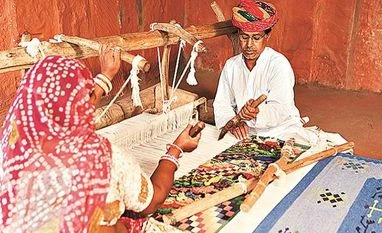 "Low-value focus a loose fit for India's textiles and clothing sector")











