A day after the second-quarter results, Sanjiv Mehta, chairman and managing director of Hindustan Unilever (HUL), India’s largest FMCG company, called upon the government to monitor inflation.
Mehta has his reasons. Crude oil (according to the WTI index ) is at levels last seen in 2014. Agricultural commodities and metals have seen a surge in prices which is hurting corporate sector profits. Companies across segments such as in FMCG, steel, cement and paints are seeing a margin contraction, despite price hikes and cost cutting measures.
An analysis of September-quarter (Q2) results declared so far shows that 14 of the top 20 companies by revenue (BSE 200) reported a decline in gross margins on a sequential basis and 13 of those reported decline on a year-on-year (YoY) basis.
Gross profit is net sales minus raw material consumed minus stock adjustment minus purchase of finished goods minus power, oil and fuel costs. Eleven of them reported a decline in operating profit margins on a sequential basis while ten saw margins decline on a YoY basis.
Among individual companies, a further analysis shows that while HUL’s gross margins declined 159 basis points (bps) on a YoY basis, its operating margins rose 6 bps during the same period, indicating the impact of cost-saving measures taken by the company.
Similarly, in the case of Nestlé, while its gross margins declined 240 bps, its operating margins fell by only 64 bps. While HUL remains cautiously optimistic about the coming quarters, it is guarded on the continued volatility in commodity prices. “Gross margins are likely to remain under pressure. Judicious pricing actions coupled with cost agility and savings programmes will continue,” it said following Q2 results.
India’s largest paint maker, Asian Paints, is also feeling the pinch of commodity price inflation. While the company reported a 32.6 per cent increase in consolidated revenue in Q2, its net profit fell by 29 per cent.
The company’s gross margin and operating margin fell by a steep 966 bps and 1,057 bps on a YoY basis. Sequentially, too, these margins were down between 300-370 bps.
“The steep inflation seen in raw material prices since the beginning of this calendar year has been phenomenal and has impacted gross margins across all businesses in the quarter,” said Asian Paints MD and CEO Amit Syngle.
Analysts led by Varun Lohchab at HDFC Securities have cut their Ebitda estimates and, consequently, their net profit projections for Asian Paints by 15-16 per cent for FY22 and 6-7 per cent for FY23 and FY24. The company is looking at further price hikes to mitigate the cost impact and is hopeful of a strong rebound in Q3.
In consumer durables, Havells has flagged the risks of commodity price volatility. Its gross margin declined 605 bps in the second quarter due to higher raw material costs. The net profit was down 7 per cent YoY at Rs 302 crore during the quarter.
“The price of zinc, aluminium, and stainless steel is rising since January. Ocean freight rates are up four times compared to December 2019. We will continue to see commodity price pressure till next March,” said B Thiagarajan, managing director of air-conditioning major Blue Star.
The firm took price hikes three times this year but has not seen an adverse impact on demand. “Demand has been good. We will have to wait and see how it pans out at Diwali,” said Thiagarajan.
Prices of several commodities are up by 30-100+ per cent over last year. Among them, tin and crude oil prices have gained over 100 per cent while those of aluminium, copper and lead are up 40-68 per cent. Palm oil prices have risen nearly 78 per cent.
Steel manufacturers are bearing the brunt of higher coal prices while sharp increases in coal and pet coke prices have dented the profitability of cement companies.
UltraTech, India’s largest cement maker, reported a YoY decline of 147 bps and 427 bps in its gross and operating margin, respectively.
Another cement maker, ACC, saw gross margins declining 88 bps, but operating margins rose 59 bps, the latter aided by cost-saving measures.
JSW Steel, which has reported its highest-ever revenue and profit growth in Q2 has also seen the cost impact on its standalone operations. “On a YoY basis, (standalone) Ebita was higher by 108 per cent. The margin was lower QoQ (sequentially) primarily due to elevated raw material prices of iron ore, coking coal and other key inputs like power, natural gas and ferroalloys,” said JSW Steel.
The expected revival in construction and infrastructure in H2 of FY22 and increased government spending are positives for the sector.
“While inflation is impacting companies globally, Indian manufacturers have to deal with sectoral challenges too. In the FMCG space, it is the explosion of e-commerce companies while in auto, it is the launch of e-vehicles. The cement sector is being impacted by overcapacity and underutilisation,” said G Chokkalingam, founder, Equinomics Research & Advisory.
Firms will have to focus on cost savings and productivity improvements. A good monsoon should also help in broad based growth and demand recovery, added Chokkalingam.
Services are not immune to the heat. While IT services companies are not directly impacted by commodity prices, supply-side constraints (labour) impacted Q2 margins for most top players.
Though TCS reported a 10 bps expansion on a sequential basis, for a traditionally strong quarter the Street was expecting a better performance.
Infosys reported Ebit (earnings before interest and tax) margins of 23.6 per cent down 10 bps. But it managed the supply side pressure well with cost optimisation levers. At Wipro, the salary impact brought down margins by 10 bps. The company expects margins to be under pressure in the coming quarters. However, despite headwinds, the IT industry players have managed to maintain margins at elevated levels as growth has been robust.

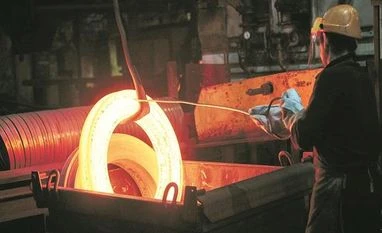 "Rocketing raw material costs hit India Inc margins in September quarter")












