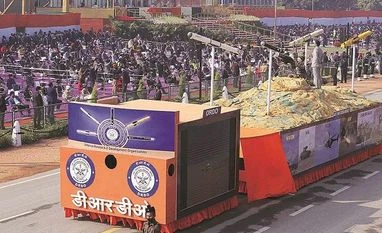
Prominent at the Republic Day parade on Tuesday was a tableaux depicting the missile programme of the Defence R&D Organisation (DRDO). But one of the missiles featured — the Akash New Generation (Akash NG) surface-to-air missile (SAM) — had already made a splash a day earlier, with its successful maiden test launch at Balasore, off the coast of Odisha.
The Indian Air Force (IAF) and the army already operate nine batteries of the venerable, but reliable, Akash missile. This is now being improved into the Akash-NG — a new generation SAM, engineered to shoot down extremely high-performing fighter aircraft — termed “high-manoeuvring, low radar cross-section aerial threats” by the IAF.
The key advantage of the Akash NG is its brand-new rocket motor. Instead of the old ramjet that powered the legacy Akash missile, the new version has a two-pulse, solid rocket motor. This gives it a longer range of 30 km and the ability to generate a high terminal velocity, outperforming even the fastest and most agile enemy fighter.
“When the second pulse motor is fired, the Akash NG speeds up and no enemy aircraft can get away,” said a DRDO scientist involved in the development of the new missile.
Making the Akash NG even more deadly is its entirely indigenous seeker head, which has been developed by the DRDO laboratory, Research Centre Imarat (RCI). This locks onto the enemy aircraft and continuously guides the Akash NG warhead to its impact point with the target.
The Akash NG detects enemy fighters at ranges out to 80 km. By the time the enemy aircraft is 50 km away, the Akash NG’s computers have calculated the launch trajectory and impact point, and the missile is launched. In just over a minute, the Akash NG missile blazes its way to the impact point 30 km away and strikes the target.
The rocket itself has been re-engineered almost completely and has been brought down from the legacy Akash’s weight of 700 kg to a sleek 350 kg. That allows the Akash NG launchers to carry more than the three missiles that the legacy Akash launcher carried.
The IAF has already inducted seven units of the Akash missile, while the army has inducted two units and has another two on order. Defence ministry sources said the army is likely to incorporate several features of the Akash NG in its current order.
The IAF has part-funded the development of the Akash NG. Costs are likely to reduce if interest from foreign buyers of the cheap, hardy missile translates into export orders.
In December, the Union Cabinet approved exporting the Akash missile system. The government has been pursuing sales to southeast Asian countries that are wary of Chinese aggression, including Vietnam and the Philippines. There is also interest from several African countries.
The defence ministry has announced that indigenisation levels in the Akash are above 96 per cent. Bharat Electronics is the lead integrator for the IAF’s Akash squadrons, while Bharat Dynamics is the lead integrator for the Army order. Many of the Akash’s sub-systems have been outsourced to private industries.
“The Akash NG test on Monday validated the missile’s propulsion, aerodynamics and control systems,” said a DRDO scientist. “Two more series of tests will follow — first of its guidance system and seeker and then of its warhead. By the year-end, if all goes well, the Akash NG will be ready to enter manufacture.”

 "Akash NG surface-to-air missile scores in maiden Republic Day eve test")











