
Amarnath Yatra: Drones, mine-proof vehicles to be used for security
The pilgrimage to the Amarnath Gupha, a holy place for Hindus in Jammu and Kashmir, is marked by devotion, religious tolerance and brotherhood
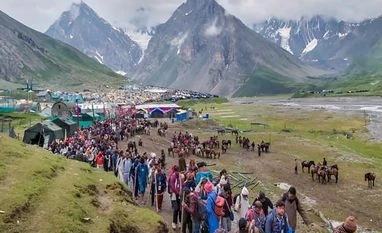 "Amarnath Yatra: Drones, mine-proof vehicles to be used for security")
WebinarsNew
Deep DiveNew
Explore Business Standard
The pilgrimage to the Amarnath Gupha, a holy place for Hindus in Jammu and Kashmir, is marked by devotion, religious tolerance and brotherhood
To ensure full-proof security to the Amarnath yatra, drone and mine-proof vehicles will be used, said Jammu and Kashmir Police on Sunday.
"Full-proof security will be provided to Amarnath yatra like last year. Drones and mine-proof vehicles will be used. I am confident that by the time of yatra, the number of terrorists here will be reduced. Right now, the number of local terrorists has come down to 28. It will reduce this further," said Additional Director General of Police (ADGP) Kashmir Zone Vijay Kumar.
The pilgrimage to the Amarnath Gupha, a holy place for Hindus in Jammu and Kashmir, is marked by devotion, religious tolerance and brotherhood.
Inside the Amarnath Gupha is an old 'Linga' of Lord Shiva. Pilgrims come from all over India to have darshan here. Hindus believe that this was the abode of Lord Shiva, located 168 km from the district headquarters in the Anantnag district.
Located 141 km from the capital Srinagar at an altitude of 12,756 feet above sea level, Gupha lies in the Ladar Valley, which is covered by glaciers, and snow-capped mountains for most of the year.
Common pilgrims are allowed to come here for darshan only for a limited time in summer. There are two main routes to reach here, one is beyond the town of Pahalgam and the other is the route to Baltal via Sonawar, a popular tourist spot in the Ganderbal district.
A 43-km hill trek starts from Chandiwadi and Noonan base camps in Pahalgam. Some people also avail the option to go on horses or palanquins to cover the trek. The shortest route is from Bal Tal which is 16 km but that's more challenging.
Prior to 1990, the pilgrimage was very exclusive and available to only sadhus and saints to visit. In 1995, the pilgrimage was held for 20 days. From 2004 to 2009, its duration was increased to two months. The pilgrimage now lasts for 40 to 45 days between July and August.
(Only the headline and picture of this report may have been reworked by the Business Standard staff; the rest of the content is auto-generated from a syndicated feed.)
First Published: Mar 20 2023 | 6:55 AM IST


 Connect with us on WhatsApp