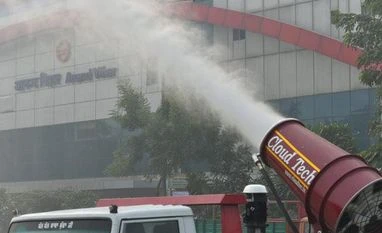
'Anti-smog gun' used in Anand Vihar; little effect on reducing pollution
The device sprays atomized water up to a height of 50 metres, creating artificial mist, which is in turn expected to stick to air-borne pollutants and bring them down to the ground
Press Trust of India New Delhi The Delhi government today sprayed water from an 'anti-smog gun' at the highly-polluted Anand Vihar area, but it had very little effect in containing the level of particulates, and they kept rising by the hour.
The device sprays atomized water (tiny droplets of water) up to a height of 50 metres, creating artificial mist, which is in turn expected to stick to air-borne pollutants and bring them down to the ground.
One such device was tested at Anand Vihar, near a pollution monitoring centre, in the presence of Environment Minister Imran Hussain and senior officials of the environment department.
Hussain said the government will take a call on whether to use it elsewhere in the city after monitoring data collected by a team of Delhi Pollution Control Committee (DPCC).
However, the real-time concentration of PM2.5 and PM10 at the Anand Vihar monitoring station of the DPCC increased from around 10 am, when the trial started.
The hourly-readings of PM2.5, were 444, 421, 476, 509 and 460 between 10 am and 2 pm while the corresponding readings of PM10 were 630, 608, 736, 842 and 702 microgram per cubic metre (ug/m3).
The 24-hour prescribed standards of these ultrafine pollutants, which trigger respiratory and cardiovascular issues, are 60 and 100 respectively.
Interestingly, the pollution levels did not drop despite the fact that the water spraying from the device, which costs around Rs 20 lakh per unit, was largely centred around the DPCC monitoring station.
Vivek Chattopadhyay, the program manager for Clean Air and Sustainable Mobility at the Centre for Science and Environment (CSE), said the effect of such devices are limited by space and time.
"The range of such devices are very limited. It affects, if at all, the air volume of the immediate surroundings of where the spraying is done. The effect diminishes after the spraying is stopped," he said.
Chattopadhyay said resources should instead be mobilised in tackling the sources of pollution by taking small yet more effective measures such as preventing open burning of garbage and scientific management of landfill sites.
Anand Vihar, a densely populated commercial zone in east Delhi, remains severely polluted through the year due to the presence of a bus terminus, which is unpaved at many places, and its proximity to the Uttar Pradesh border where a large volume of trucks ply.

 "'Anti-smog gun' used in Anand Vihar; little effect on reducing pollution")


 Connect with us on WhatsApp