APJ Abdul Kalam will be laid to rest at his home town Rameswaram
Mortain remains will be flown from Delhi to Rameswaram today evening
T E NarasimhanGireesh Babu Chennai The temple town of Rameswaram in Ramanathapuram district of Tamil Nadu will be the place where the country's former President and eminent scientist APJ Abdul Kalam will be laid to rest. His mortal remains are expected to be flown into the town by today evening.
Prime Minister Narendra Modi, along with the three service chiefs, will receive the mortal remains of the former president at the technical area of the Indira Gandhi International Airport in Delhi, before it is sent to Ramerswaram.
"The casket containing the mortal remains of Kalam will be taken from Palam to his residence in a gun carriage," defence ministry spokesperson Sitanshu Kar said.
The public can pay homage to Kalam from 3 p.m onwards at 10 Rajaji Marg here.
Hundreds of people, from cross section of societies and religion have also gathered near Dr. Kalam's house in Rameswaram, waiting to pay their last respects to India's 'Missile Man'.
The central government will soon communicate details on when his body would be taken to Rameswaram to the State government and local authorities, a senior official from Ramanathapuram district said.
Dr. Kalam was born on October 15, 1931 in the island town of Rameswaram, almost 600 kilometers away from Chennai, in a lower middle class Tamil family. In his autobiography, Wings of Fire, he recalled that he had a very secure childhood, both materially and emotionally in his hometown.
His father, Jainulabdeen, despite not having much formal education or much wealth, possessed great innate wisdom and a true generosity of spirit. He had an ideal helpmate in Kalam's mother, Ashiamma, said Kalam in his book.
"I do not recall the exact number of people she fed everyday, but I am quite certain that far more outsiders ate with us than all the members of our own family…We lived in our ancestral house, which was built in the middle of the 19th century. It was a fairly large pucca house, made of limestone and brick, on the Mosque Street of Rameswaram. My austere father used to avoid all inessential comforts and luxuries. However, all that was needed was provided for, in terms of food, medicine or clothes," he wrote.
He added that he inherited honesty and self-discipline from his father and faith in goodness and deep kindness from his mother, along with his three brothers and sisters in his childhood. He also recalls his friendship with Ahmed Jallaluddin, a close friend and his first cousin Samsuddin there. "But it was the time I spent with Jallaluddin and Samsuddin that perhaps contributed most to the uniqueness of my childhood and made all the difference in my later life. The unschooled wisdom of Jallauddin and Samsuddin was so intuitive, responsive to non-verbal messages that I can unhesitatingly attribute my subsequently manifested creativity to their company in my childhood,” he said in his book.
After completing his primary school education in Rameswaram, he joined Schwartz High School at Ramanathpuram. He recalled that by the time he completed education at Schwarz, he was a self confident boy with determination to be successful. From there, he went to Tiruchchirapalli for his higher studies.
According to officials the administration is taking steps to make necessary arrangements as thousands of people assembling to pay homage to the former President.
Dr. Kalam died on Monday evening in a private hospital in Shillong in Meghalaya.
He collapsed at the Indian Institute of Management-Shillong (IIM-Shillong) while giving a lecture to the students on “Livable Planet” on Monday evening and was taken to the hospital.

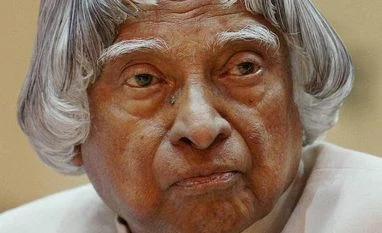 "APJ Abdul Kalam will be laid to rest at his home town Rameswaram")


 Connect with us on WhatsApp