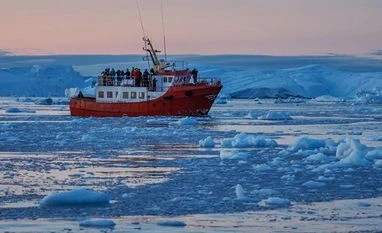
Arctic temp anomaly to be over three times as large as global mean anomaly
A report released on Tuesday said that the Arctic temperature anomaly is likely to be more than three times as large as the global mean anomaly in certain conditions in the northern hemisphere
IANS Geneva The 'Global Annual to Decadal Climate Update' released on Tuesday said that the Arctic temperature anomaly is likely to be more than three times as large as the global mean anomaly in certain conditions in the northern hemisphere.
The Arctic temperature anomaly, compared to the 1991-2020 average, is predicted to be more than three times as large as the global mean anomaly when averaged over the next five northern hemisphere extended winters, the 'Global Annual to Decadal Climate Update' issued by the World Meteorological Organization (WMO).
"As long as we continue to emit greenhouse gases, temperatures will continue to rise. And alongside that, our oceans will continue to become warmer and more acidic, sea ice and glaciers will continue to melt, sea level will continue to rise, and our weather will become more extreme. Arctic warming is disproportionately high and what happens in the Arctic affects all of us," said WMO Secretary-General Petteri Taalas.
Leon Hermanson from the United Kingdom's Met Office, who led the report, said, "Our latest climate predictions show that continued global temperature rise will continue, with an even chance that one of the years between 2022 and 2026 will exceed 1.5 degrees Celsius above pre-industrial levels. A single year of exceedance above 1.5 degrees Celsius does not mean we have breached the iconic threshold of the Paris Agreement, but it does reveal that we are edging ever closer to a situation where 1.5 degrees Celsius could be exceeded for an extended period."
It has clearly said the chance of temporarily exceeding 1.5 degrees Celsius has risen steadily since 2015, when it was close to zero. For the years between 2017 and 2021, there was a 10 per cent chance of exceedance. That probability has increased to nearly 50 per cent for the 2022-2026 period.
The Paris Agreement sets long-term goals to guide all nations to substantially reduce global greenhouse gas emissions to limit the global temperature increase in this century to 2 degrees Celsius while pursuing efforts to limit the increase even further to 1.5 degrees Celsius.
There is no signal for the El Nino Southern Oscillation for December-February 2022/23, but the Southern Oscillation index is predicted to be positive in 2022.
Predicted precipitation patterns for the November to March 2022/23-2026/27 average, compared to the 1991-2020 average, suggest increased precipitation in the tropics and reduced precipitation in the subtropics, consistent with the patterns expected from climate warming, the Update said.
(Only the headline and picture of this report may have been reworked by the Business Standard staff; the rest of the content is auto-generated from a syndicated feed.)

 "Arctic temp anomaly to be over three times as large as global mean anomaly")


 Connect with us on WhatsApp