After almost a decade of relative peace on the Line of Control (LoC) — the mountainous, 776-km, de facto border between Pakistan Occupied Kashmir (PoK) and the rest of Jammu & Kashmir (J&K) that remains with India — in early 2013 saw resumption of firing and aggressive patrolling of the LoC from both sides. Sporadic flare-ups since then have been mostly controlled without significant casualties.
This week, however, has seen firing spread from the LoC to the plains sector of Jammu, along the border between J&K and Pakistani Punjab. Media reports are erroneously calling this the “international boundary” or IB.
In fact, the IB — promulgated by Sir Cyril Radcliffe on August 17, 1947, and accepted by both India and Pakistan — runs between the Indian states of Gujarat, Rajasthan and Punjab, and the Pakistani provinces of Sindh and Punjab. Since the 1971 war, India and Pakistan have never exchanged fire across the IB.
The on-going firing involves Indian posts and villages in J&K, which begins near Pathankot and runs north for 200 km to Akhnur, where the LoC begins. Pakistan calls this the “working boundary”, since it is contested like the rest of J&K. By firing here, Pakistan demonstrates that it remains unsettled.
On Thursday, Defence Minister Arun Jaitley said, “The international border has never been an issue at all and most of these violations are occurring at the IB.” In fact, for Pakistan, the “working boundary” is a part of the J&K dispute.
Targeting civilians in the plains sector, in villages like Arnia, gives Pakistan a softer option than tangling with India on the LoC, where Indian military posts are well fortified; and even mortars and machine guns cause only limited damage. Rather than facing robust Indian Army retaliation on the LoC, Pakistan is targeting the BSF, and villages along the “working boundary”.
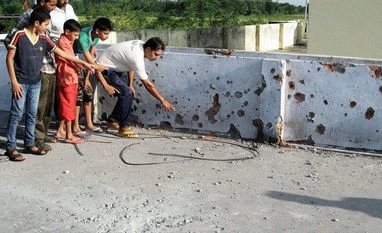
Since Wednesday, firing has died down along the LoC, but continues along the so-called “working boundary”, where both sides have reported civilians casualty. Each side has evacuated some 20,000 border villagers to safety away from the border.
This is not unprecedented. Prior to the LoC ceasefire of November 2003, both sides would target border villages, causing casualties to civilians. Border villages take survival cues from the military, often building underground bunkers next to their homes, into which they scurry when firing starts. Even so, civilians sometimes get caught in the open when enemy guns first open fire.
Senior Indian commanders assess that the Pakistan Army is activating the border to rally support at a time when nationalist and Islamist groups are protesting the army’s attack on North Waziristan, accusing it of acting at America’s behest. Pakistan’s military is also taking flak for recent drone strikes on militant targets.
“Pakistani generals want a mildly activated border to keep alive the India bogey. Strong army chiefs like (General Pervez) Musharraf and (General Ashfaq) Kayani did not need to whip up the India bogey. But the current chief, General Raheel Sharif, needs to play the India card. I think we will have to live with a more active border,” predicts a top Indian general.
Furthermore, India’s suspension of the dialogue process has reduced Pakistan’s incentive to keep the peace. When the dialogue process was under way, even if sporadically, ceasefire violations incurred a cost — firing on the border disrupted the dialogue. With dialogue suspended, there is no diplomatic cost to ceasefire violations.
New Delhi, therefore, must now rely on imposing a military cost, through strong retaliation against Pakistani posts and villages. With Indian posts on the LoC better constructed and more heavily armed than Pakistan’s, an escalation of firing imposes disproportionate costs on the Pakistan Army. The BSF too has been instructed to retaliate strongly. New Delhi’s decision not to call for a flag meeting underlines its conviction that the military cost will soon become too high for Pakistan.
Top operational commanders from both sides — the directors general of military operations, or DsGMO — spoke briefly on the telephone earlier this week. Each side accused the other of violating the ceasefire. However, neither side requested for a flag meeting, where de-escalation is normally initiated.
"Pakistan, in these attacks, has clearly been the aggressor… If Pakistan persists with this adventurism, our forces will make the cost of this adventurism unaffordable," said Jaitley on Thursday.
It has been speculated that Pakistan has stepping up cross-border firing to infiltrate militants into J&K before the winter snows block the passes from POK. In fact, the infiltration routes around Poonch, Rajauri and Naushera — in the lower-lying Jammu Sector — remain open around the year.
Nor is it likely that Pakistan has activated the border to disrupt India’s counter-infiltration grid. The Indian Army prefers an operating environment where fire can be opened quickly on suspected infiltration. The ceasefire restrains India’s posts as much as Pakistan’s. If there is no de-escalation soon, infiltrating militants will face a more hostile reception at the LoC than they have since the ceasefire of November 2003.

 "After a decade of calm, army gears up for active border")


 Connect with us on WhatsApp