Home / Health / Delhi Metro commuters turning complacent amid surge in Covid-19 cases
Delhi Metro commuters turning complacent amid surge in Covid-19 cases
Amid a surge in coronavirus cases in the national capital, metro commuters are exhibiting complacent behaviour with many not putting on masks properly, not sitting on alternate seats
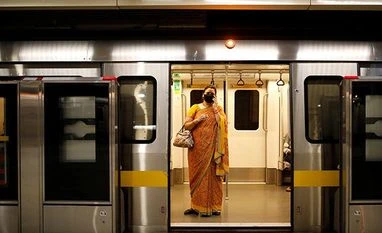
A passenger wearing face mask takes a train at a Delhi metro train station, on the first day of the restart of their operations, amidst the spread of coronavirus disease (COVID-19), in New Delhi. Photo: Reuters
At a time when there is a surge in coronavirus cases in the national capital, metro commuters are exhibiting complacent behaviour with many not putting on masks properly, not sitting on alternate seats, thereby increasing the threat of spread of the infection.
The lifeline of the Capital witnesses footfalls of lakhs of commuters, but pandemic lethargy seems to have taken over the people. Many travellers could be seen wearing masks below their noses or down to their necks and a blind eye is being turned to the big red cross on alternate seats. Besides this, social distancing has also gone for a toss, people stand neck-and-neck in the crowded metro during the peak hours on a few Lines, eat food and talk over the phone with masks down. According to the experts, public transport could become a hotspot of infection if safety norms are not followed.
Notably, visits of the flying squad have also become sparse. On being asked about this, the Delhi Metro Rail Corporation said that teams have been deployed to randomly check the trains for any kind of violation and counsel people to refrain from doing so for their and everyone's safety.
Anuj Dayal, Executive Director of Corporate Communications told IANS, "The teams penalize for creating nuisance such as not wearing masks or maintaining social distancing. Regular announcements inside the trains and station premises are also being made to create mass awareness."
Delhi Metro train services were suspended from March 22 and resumed on September 7 in a graded manner in compliance with the Covid-19 safety norms. According to Delhi Economic Survey report 2020-21, the average daily passengers before the lockdown was nearly 57 lakhs, which has now plummeted to about 10 lakhs.
Post resumption of services, DMRC, however, had taken stringent steps like maintaining social distancing, no-cash transactions, running more trains during off-peak hours for ensuring safety of passengers. DMRC needs to be stricter now as the cases are increasing.
In an interview to IANS in September, DMRC Managing Director Mangu Singh had emphasized that entry points would be temporarily closed if the crowd becomes unmanageable and people's smart cards will also be blocked in case precautionary measures are not followed during the trip.
Delhi, among other states, is also recording the highest daily cases of this year. On Friday, the city breached the 700-mark of cases after three months. Health experts have attributed this sudden rise to people turning complacent and not following Covid-19 appropriate behaviour.
(Aakanksha Khajuria can be contacted at aakanksha.k@ians.in)
--IANS
aka/bg
(Only the headline and picture of this report may have been reworked by the Business Standard staff; the rest of the content is auto-generated from a syndicated feed.)

 "Delhi Metro commuters turning complacent amid surge in Covid-19 cases")


 Connect with us on WhatsApp