
Delhi's air quality 'very poor' as mercury, windspeed decline
The city's 24-hour average air quality index (AQI) was 361
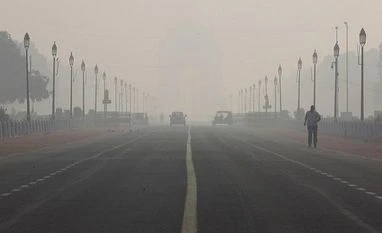 "Delhi's air quality 'very poor' as mercury, windspeed decline")
WebinarsNew
Deep DiveNew
Explore Business Standard
The city's 24-hour average air quality index (AQI) was 361
Delhi's air quality slipped into the "very poor" category on Wednesday as low temperatures and slow surface winds allowed the accumulation of pollutants.
The city's 24-hour average air quality index (AQI) was 361.
According to India Meteorological Department, Delhi recorded a minimum temperature of 9.2 degrees Celsius, this season's lowest so far. The maximum temperature settled at 28.8 degrees Celsius.
Strong winds on Sunday and Monday had led to an improvement in the air quality.
The 24-hour average AQI read 290 on Tuesday, the second-best AQI reading this month since November 1 when it was 281. Delhi has seen 'very poor' or 'severe' air quality on the rest of the days.
Neighbouring Faridabad (367), Ghaziabad (366), Greater Noida (312), Gurgaon (305) and Noida (325) also saw a dip in air quality on Wednesday.
An AQI between zero and 50 is considered 'good', 51 and 100 'satisfactory', 101 and 200 'moderate', 201 and 300 'poor', 301 and 400 'very poor', and 401 and 500 'severe'.
The Ministry of Earth Sciences' air quality monitor SAFAR said slow local surface winds will reduce dispersion of pollutants over the next three days, leading to deterioration in air quality.
A slight improvement is likely from November 27 with an increase in local surface wind speed.
"With the onset of winter, local weather is likely to be the dominating (factor) in determining air quality," SAFAR said.
Even as the air quality turned 'very poor' again, the Delhi government on Wednesday decided to resume physical classes in schools, colleges and other educational institutions and reopen government offices from November 29.
The ban on the entry of trucks, barring those engaged in essential services, will continue till December 3. However, "CNG and electric trucks will be allowed to enter Delhi from November 27", Environment Minister Gopal Rai said after a meeting to review curbs to tackle air pollution.
On November 13, the city government had ordered the closure of all educational institutes, banned construction and demolition activities and asked its employees to work from home to combat air pollution and minimise its health effects.
Four days later, it extended the restrictions, besides banning the entry of trucks carrying non-essential items in Delhi.
The ban on construction and demolition activities was lifted on Monday in view of an improvement in the air quality and inconvenience caused to workers.
(Only the headline and picture of this report may have been reworked by the Business Standard staff; the rest of the content is auto-generated from a syndicated feed.)
First Published: Nov 24 2021 | 8:19 PM IST


 Connect with us on WhatsApp