GM field trials: Regulator proposes but most states decline
A Business Standard survey shows a majority of the states still firmly against the move while some others are open to consider it only conditionally
BS Reporters Mumbai The Genetic Engineering Approval Committee (GEAC) has approved field trials for 11 crop varieties but that clears only the first hurdle in the way of genetically-modified crops. Another major hitch could come from state governments, most of which do not seem to be in a mood to give their go-ahead anytime soon.
A survey conducted by Business Standard reveals that a majority of the country’s states are still firmly against the move, while a few are open to considering only conditionally. Some others are either neutral or might take a decision after the Lok Sabha elections.
According to GEAC officials, maize, mustard and rice are among the crops that have got approval for trials, but the states that are major producers of these crops remain opposed.
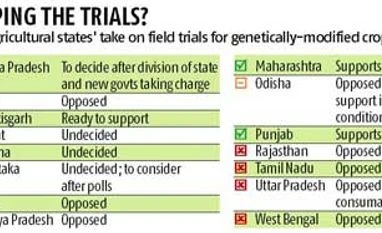
A piece of good news, though, has come from Maharashtra and Punjab, two of the largest agricultural states, which have favoured field trials for GM crops.
Officials say the use of high-yield GM crops could prove beneficial, given the growing demand for food grains, vegetables and oil seeds. But apprehensions of health hazard on the use of such seeds for consumable agricultural commodities seem to be playing a spoilsport. India had suspended field trials of these crops a few years ago but the GEAC approval last week for 11 varieties brought the issue back in the limelight.
The environment & forests ministry had in July 2011 made it mandatory for companies, institutes and research bodies to get no-objection certificates from states concerned before conducting trials. Also, GEAC analyses the sites for these trials on several parameters, including whether these are located too close to sanctuaries or water bodies.
States like Uttar Pradesh and Odisha support GM crops, but with conditions. UP supports BT cotton but is opposed to use of GM seeds for consumable crops. Odisha, on the other hand, says it can permit trials but farmers’ rights on seeds will also have to be factored in.
Andhra Pradesh is home to several seed companies and BT Cotton was first introduced there. However, the state remains undecided on allowing field trials for GM crops. A decision on this will have to wait for the impending division of the state and formation of new governments. A technical committee is studying the issue.
Gujarat and Karnataka have not opposed the trials yet. The two are said to take a call only after the Lok Sabha elections. Major southern states like Tamil Nadu and Kerala, on the other hand, are against GM crops and unwilling to permit field trials. While Madhya Pradesh opposes field trials as a policy, Chhattisgarh might support if the Centre takes it on board. Punjab is open to field trials for maize, while Haryana is undecided.
The Maharashtra government has issued no-objection certificates to 28 applications for GM crop trials to seven private companies and the Nagpur-based Central Institute of Cotton Research.
Most of the 28 strains cleared for trials are of wheat, rice, maize and cotton. It will be Haryana’s Bayer Bio Science for rice, Dow Agro Sciences, Pioneer Overseas Corporation and Syngenta Bio Sciences for maize, and Maharashtra Hybrid Seeds for wheat.
At present, use of GM seeds is permitted only for cotton, so 95 per cent of India’s cotton crop is BT. But allowing genetic engineering on consumable crops like food grains, oilseeds and vegetables has made the issue a contentious one.
Our bureaus in different cities contributed to this report

 "GM field trials: Regulator proposes but most states decline")


 Connect with us on WhatsApp