Governments — whether under the Congress or the BJP — appear to believe petrol prices are a crucial element in the voter calculus. A reflection of this was the freeze in an upward revision in April-May 2019 (during the General Election), even though international crude oil prices were rising. But within 10 days after the last phase of the election, oil prices started to increase by 70-80 paise per litre.
Then, an industry source had argued: “While state-owned fuel retailers Indian Oil Corp (IOC), Bharat Petroleum Corp (BPCL) and Hindustan Petroleum Corp (HPCL) had in the past completely frozen rates at the time of elections, they during the Lok Sabha polls moderated the revision by not passing on all the desired increase in rates to consumers.”
The companies imposed a 19-day price freeze on petrol and diesel ahead of the Karnataka polls in May 2018 despite international fuel prices going up by nearly $5 a barrel. But, as soon as the election was over, they rapidly passed on the increase to customers — following over 16 consecutive days of price increase after May 14, 2018, petrol had become costlier by Rs 3.8 per litre and diesel by Rs 3.38.
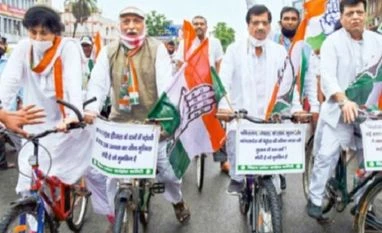
On May 26, 2014, when Modi took as prime minister, petrol in Delhi was Rs 71.41 a litre and diesel was Rs 56.71 a litre. Since then (as of July 2), petrol has become dearer by 13 per cent (Rs 80.43 a litre) and diesel by 42 per cent (Rs 80.53 a litre). It was this inverse relation between crude oil prices and fuel cost that became the centrepiece of Congress President Sonia Gandhi’s attack on the NDA government last week when she dubbed the hike in fuel prices “a new example of extortion”.
“I demand the Modi government immediately roll back the increase in prices. I also urge it to roll back the rise in excise duty on petrol and diesel... This is not only unjust but insensitive too,” she said. A major reason for the hike in fuel price is the increase in excise duty by the Centre and value-added tax (VAT) by states.
In April 2014, a month before the Modi took charge, the excise duty on petrol was only Rs 9.48 a litre, which jumped to Rs 32.98 a litre now. The excise duty on diesel increased close to eightfold, from Rs 3.56 a litre in April 2014 to Rs 31.83 a litre now.
Gandhi said the increase in the excise duty helped the Modi government collect extra revenue of nearly Rs 18 trillion.
In response to Gandhi’s allegation, Petroleum Minister Dharmendra Pradhan highlighted the Congress-led governments, or those run by its allies, such as in Rajasthan, Punjab, Maharashtra, Jharkhand, and Puducherry, had also put a burden on the public by increasing state taxes on fuel by Rs 5.
In Delhi, ruled by the Aam Aadmi Party, the VAT on diesel increased from 16.75 per cent to 30 per cent and on petrol from 27 per cent to 30 per cent in May.
"Now, the government is not taking any burden on fuel. Instead, they added cess and surcharge, and increased duties, too; we never used to do that... I don’t think even in Pakistan it (excise duty) is so high,” Moily said, demanding the government consider an administered regime if it is not ready to bring down the excise duty.
But politics does not allow this.
One subscription. Two world-class reads.
Already subscribed? Log in
Subscribe to read the full story →
Smart Quarterly
₹900
3 Months
₹300/Month
Smart Essential
₹2,700
1 Year
₹225/Month
Super Saver
₹3,900
2 Years
₹162/Month
Renews automatically, cancel anytime
Here’s what’s included in our digital subscription plans
Exclusive premium stories online
Over 30 premium stories daily, handpicked by our editors


Complimentary Access to The New York Times
News, Games, Cooking, Audio, Wirecutter & The Athletic
Business Standard Epaper
Digital replica of our daily newspaper — with options to read, save, and share


Curated Newsletters
Insights on markets, finance, politics, tech, and more delivered to your inbox
Market Analysis & Investment Insights
In-depth market analysis & insights with access to The Smart Investor


Archives
Repository of articles and publications dating back to 1997
Ad-free Reading
Uninterrupted reading experience with no advertisements


Seamless Access Across All Devices
Access Business Standard across devices — mobile, tablet, or PC, via web or app
)