Technology has massively impacted every aspect of our lives over the past 30 years. It has transformed how we work, communicate, find information, stay in touch, travel, eat, shop, consume content, stay healthy and even get entertained. Remarkably, one of the most impactful aspects our life, namely higher education, has resiliently remained relatively undisrupted by technology.
By and large, at most of the higher education institutions (HEIs), students still attend classes taught by knowledgeable faculty, read from textbooks and handouts, take tests and exams, do projects, get grades and a degree certificate. This was the case half a century back and still remains the case. Of course, it has become easier for students to research online (as well as to plagiarise), share and learn from each other. And there are high tech projectors, computers, AV systems (and in some cases smartboards) in the classroom rather than slide projectors and chalk boards. But the basic teaching-learning process remains largely the same.
Is that really so? While I have painted an extreme picture to make my point that technology has not really disrupted or impacted the core of higher education yet, that picture is not entirely accurate. If we look at the various dimensions of higher education, there are aspects where technology has gained massive penetration and others where there is very little. Let us take a deeper look.
Take the business process of education. If the various activities in higher education are viewed as business processes, then process and workflow Automation through ERP (enterprise resource planning) has gained substantial penetration across reputed HEIs around the world. All the processes including admissions, fee payments, course planning and scheduling, faculty and other teaching resource management, learning material distribution, student information tracking, etc, have all been automated using technology. In fact, these systems — ERP, SIS (student information systems), LMS (learning management systems), etc — have even moved to the cloud in the past few years. Thus, it’s fair to say that the business processes of higher education has been streamlined and automated by technology saving a lot of paper, time and reduced possibility of human error.
What about the actual teaching-learning process? Technology has also made its way peripherally into the teaching-learning process in several ways. Some of these include:
Learning management systems: Many of the good HEIs around the world now use some kind of LMS which digitally facilitates several aspects that were earlier handled manually or physically. This includes digital distribution of learning material, information sharing like announcements, grades, etc,
Lecture capture systems: Fairly common now at high quality HEIs are these systems which capture the classroom lectures digitally and make them available as videos to learners to view at their leisure.
Online learning resources: There are many high quality, free,open education resources (OERs), like Merlot, MIT Open Courseware, Apple University, YouTube, etc available now to both teachers and students. This empowers teachers by reducing the burden on them to create material from scratch.
Online learning: There has been a massive surge in online learning itself ranging from online programmes now offered by many leading HEIs, to MOOCs such as Coursera and EdX. I use the qualifier peripherally since none of them fundamentally change the predominant pedagogical model — the teacher educating the learner.
Does any of this improve learning? Despite all the tech-enabled interventions, the biggest determinant of learning effectiveness remains an inspiring and engaging teacher who is able to arouse curiosity, interest and engagement among learners. However, such teachers are few and far in between to make a broad based impact. So, is there nothing that technology can do to address this aspect — learning effectiveness? Turns out that there are a few ideas being used with some promising initial success.
Flipped classroom: Here, students review the course content, typically readings and recorded lectures outside the classroom, and classroom time is used to apply the knowledge and solve problems. It inverts what traditionally has been classwork and homework, but is more engaging for students .
Gamification: Game dynamics create very high engagement. These are being borrowed and implemented in the learning process by introducing fine-grained competition, leaderboards, levels, etc., across all aspects of the learning process and not just the exam results.
Learning analytics: Though still in its early days, Learning Analytics promises to be a big game changer. It enables aspects such as learner engagement, his/her understanding of concepts, difficulties being encountered, progress being made and various performance parameters to be measured, analysed and even predicted. Learning analytics brings measurement into aspects of education that have never been measured before. The resulting data can be analysed to get insights into learners both individually and collectively, to identify problem areas that students did not follow and to predict students likely to fail thus enabling necessary corrective action. Further, it can enable adaptive learning where learning resources and methods can be personalised to suit the learning dynamics of individual learners. This analysis has hitherto intuitively happened only in the minds of observant, caring and dedicated teachers. Now it can be applied broadly to have a real impact on learning effectiveness.
What more does the future hold? An emerging area ripe with potential is the use of augmented and virtual reality (AR/VR) to create immersive learning experiences that enable learning by doing rather than listening or watching, which can substantially improve learning effectiveness.
Further, with a data-driven approach slowly beginning to take hold in higher education, there is a tremendous scope to have very impactful data-led innovations. Prime among them is the notion of an artificial intelligence (AI)-enabled learning assistant. Think of your own Jarvis (from Iron Man) as a personal tutor who knows your learning preferences and behaviour intimately, what and how much you have learned and can create a customised learning experience that best suit you. IBM Watson is working on this.
Many innovative start-ups as well as the big tech giants like Google, IBM, Apple, etc, are working on disruptive innovations in education, which makes the next decade very exciting for this important aspect of our lives.
The author is vice-chairman & CEO of Great Lakes Institute of Management, & founder-CEO, Great Learning

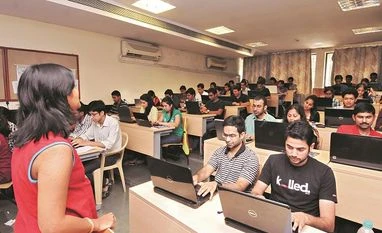 "How technology is reforming India's higher education landscape")












 Connect with us on WhatsApp