India completes arch of world's highest railway bridge in Jammu and Kashmir

The 5.6-metre steel arch is part of the Udhampur-Srinagar-Baramulla rail link project (USBRL) and a key segment of the 111-km-long stretch from Katra to Banihal in Jammu and Kashmir

railways, bridge, Chenab Bridge, world's highest railway bridge
The railway bridge over Chenab. The last piece of metal was fitted at the highest point, joining two arms of the arch, on Monday | PTI
BS Reporter New Delhi
2 min read Last Updated : Apr 05 2021 | 11:47 PM IST
The Indian Railways today achieved a major milestone by completing the arch of the Chenab Bridge — the world's highest railway bridge.

The 5.6-metre steel arch is part of the Udhampur-Srinagar-Baramulla rail link project (USBRL) and a key segment of the 111-km-long stretch from Katra to Banihal in Jammu and Kashmir. 

The last piece of metal was fitted at the highest point today, joining two arms of the arch that stretched towards each other from both banks of the river. The arch now looms over the Chenab that flows some 359 metres below.

Now that the arch is complete, the stay cables will be removed, the concrete in the arch rib will be filled, the steel trestle will be erected and after the viaduct has been launched, the railway track will be laid.

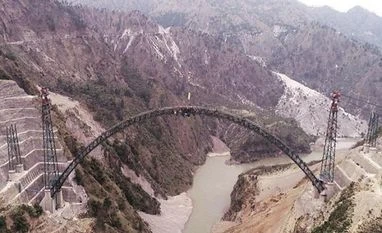
The Chenab Bridge
  • Is 1,315 metre long
  • Will be 35 m higher than the Eiffel Tower
  • Construction involved fabrication of 28,660 MT steel, 10 lakh Cum earthwork, 66,000 Cum concrete and 26 km motorable road
  • Arch consists of steel boxes
  • Length of main arch span: 467 m (linear); 550 m (curvilinear)
  • Overall weight of arch: 10,619 tonne
  • Structural steel suitable for temperature from minus 10 degree Celsius to 40 degree Celsius
  • Cost of bridge: Rs 1,486 crore
  • Life of bridge: 120 years
  • Designed to withstand high wind speed up to 266 km/hour
  • Designed for blast load in consultation with DRDO
  • Bridge to remain operational at restricted speed of 30 km/hour even after removal of one pier/trestle
  • Bridge designed to bear earthquake forces of highest intensity Zone 5
  • Phased Array Ultrasonic Testing machine used for testing of welds, a first for Indian Railways
  • Approx 584 km welding done to join different parts of the structure. That’s about the distance between Jammu Tawi and New Delhi
  • Height of cable crane’s pylon at Srinagar end is 127 m (Qutub Minar, by comparison, is 72 m high)
  • Extensive health monitoring and warning systems planned through state-of-art instrumentation
  • Executing agency: Konkan Railway Corporation

One subscription. Two world-class reads.

Already subscribed? Log in

Subscribe to read the full story →
*Subscribe to Business Standard digital and get complimentary access to The New York Times

Smart Quarterly

₹900

3 Months

₹300/Month

SAVE 25%

Smart Essential

₹2,700

1 Year

₹225/Month

SAVE 46%
*Complimentary New York Times access for the 2nd year will be given after 12 months

Super Saver

₹3,900

2 Years

₹162/Month

Subscribe

Renews automatically, cancel anytime

Here’s what’s included in our digital subscription plans

Exclusive premium stories online

  • Over 30 premium stories daily, handpicked by our editors

Complimentary Access to The New York Times

  • News, Games, Cooking, Audio, Wirecutter & The Athletic

Business Standard Epaper

  • Digital replica of our daily newspaper — with options to read, save, and share

Curated Newsletters

  • Insights on markets, finance, politics, tech, and more delivered to your inbox

Market Analysis & Investment Insights

  • In-depth market analysis & insights with access to The Smart Investor

Archives

  • Repository of articles and publications dating back to 1997

Ad-free Reading

  • Uninterrupted reading experience with no advertisements

Seamless Access Across All Devices

  • Access Business Standard across devices — mobile, tablet, or PC, via web or app

Topics :Railways Jammu and Kashmirrail projectsIndian Railways

Next Story




