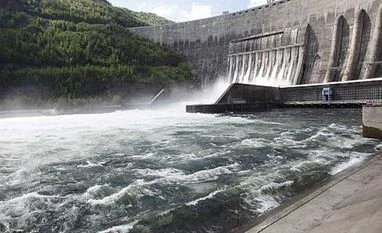
South Asian countries will be greatly benefited by a single interconnected power market that will also give India a chance to replace its fossil fuel-based generation with cleaner hydropower from countries like Bhutan and Nepal, according to Asian Development Bank.
The unanticipated shortages in one country's power grid can be readily solved by imports from a neighbouring grid, said a blog written by Priyantha Wijayatunga, ADB Director (Energy Division) for South Asia Regional Department.
A single interconnected power market is a clear win for the South Asia Subregional Economic Cooperation (SASEC) countries as the power systems of all countries would be integrated through adequate cross border transmission capacity to share power with each other, he said.
"Under this arrangement, smaller countries like Nepal and Sri Lanka would rely on market to provide reserve generation capacity, lowering their own investment costs, while fossil fuel-based generation in Bangladesh and India would be replaced with cleaner hydropower from Bhutan and Nepal."
Besides, given the different times of peak power demands of neighbouring national grids, one grid doesn't need to generate all its power to meet peak demand, it can instead buy from another grid for partial requirements, and vice versa, Wijayatunga wrote.
This "resulting diversity" reduces overall investment needs in national energy generation plans, he said.
It is beneficial to have a grid-to-grid connection for direct transfer of power from one national grid to another instead of exporting power from a generation plant to a grid, the blog said.
Like in case of India-Bangladesh power trade agreement, the latter now imports up to 500 megawatts from India under a 2013 project supported by a $112 million ADB loan, he said.
This grid-to-grid connection has significantly improved power supply and cost as well as power interruptions in Bangladesh, where shortages are rampant.
"The two countries are now looking to double capacity of their power trading arrangement financed through another ADB loan of $120 million," he said in the blog.
Wijayatunga further said the current bilateral power trade agreement among SASEC countries need to gradually expand in volume as well as beyond two-country agreements.
"Some initiatives in this regard can already be seen, like the agreement to export power from a specific generator in Nepal to Bangladesh through transmission grid in India, and preliminary discussions for Bangladesh to invest in a hydropower plant in Bhutan," he said.
"We hope they will further expand in the near future. More bilateral and multilateral power trading can pave the way to developing a single interconnected power market in the SASEC region that will benefit all countries," the blog said.

 "Interconnected power market is India's chance to use cleaner hydropower:ADB")


 Connect with us on WhatsApp