It was after finishing her bachelor’s degree in economics from Ferguson, Pune followed by a master’s degree at the Tata Institute of Social Sciences (TISS) that Iravati Damle, now 28, realised that she wanted to make a shift from economics and development studies into the space of public policy.
But coming from a non-Delhi and non-political family from the holiday town of Lonavala, Damle didn’t have the usual opportunities available to those who are in the “right circles” to make inroads into the space.
That’s when she came across Legislative Assistants To Members of Parliament (LAMP), a fellowship started by PRS India in 2010-11 to allow bright, young minds in the country to work with a Member of Parliament. Damle was selected, trained for six months on what to expect and what not to expect and attached to Jay Panda, an MP from Orissa.
That’s about the time she reckons she got “bitten by the policy bug”. Here was something for her to dig her teeth into, think about and try to fathom with all its complexities, twists and turns and irrationalities. If one manages to make sense of policy in India, one could make sense of anything!
For two years after the fellowship, Damle continued to work with Panda — he hired her himself — and it was only in 2017 that she took her first plunge into the corporate world. She is now head of policy, western and central region for Uber India.
Aparajita Bharti, born and bred in Delhi to parents who were both in government, finished her studies at the College of Business Studies, Delhi University and landed up a job with a consultancy firm in 2010. Into street theater and exposed to the impact governance and policy had on ordinary citizens, Bharti, now 29, knew her heart was not in the job she found herself in once she graduated. Yet there seemed no clear avenues for her to get into the space she was drawn to : policy making.
When the LAMP fellowship came to her notice and she decided to quit her job and apply for it, several declared her crazy. Who would leave a cushy and high paid consulting job for a hitherto unknown fellowship that paid very little ? Moreover, it was the first year of the fellowship — an experiment for PRS itself and there was no certainty it would take her anywhere.
But Bharti had the support of her parents and decided to follow her heart. She was one of 12 of the first batch of LAMP fellows, attached as luck would have it to N K Singh, one of the most knowledgeable and experienced MPs one could have landed. Post the fellowship, Bharti got chosen for another fellowship offered by the UK government and ended up doing a one year of post graduate study at Kellogg’s college in Oxford in the public policy space. Back in India, Bharti joined Snapdeal for two years in the policy division and then quit in 2016 to co-found Young Leaders for Active Citizenship (YLAC) with another LAMP fellow from her batch, carving out a niche in the policy space in a definitive and impactful manner.
Damle and Bharti’s stories are precisely what board member and co founder C V Madhukar and M R Madhavan, founder and president of PRS India — an independent not for profit organisation dedicated to making the Indian legislative process better, more transparent and participatory — had in mind when they started the fellowship in 2010.
How can bright, young minds be brought into the area of politics and policy-making? How can they be more aware and engaged ? How can they understand our Parliamentary system, democratic institutions and policy making tools from a real world point of view rather than through a civics text book? A secondary objective was that they had seen that MPs — PRS had been working with them for around five years already — don’t have any dedicated research support. This would serve that purpose too.
The first batch was started with 12 fellows. Fellows have to be 25 years of age and below, hold an undergraduate degree in any subject and willing to be based in Delhi for the year of the fellowship. A one month 9 am to 5 pm training exposes fellows to economics, Parliamentary processes, how replies are framed and structured, how and where to research answers and how to write.
The fellows who act as a legislative assistant help with all Parliamentary work. This can include help with answers to Parliamentary questions, research, writing on various Bills to be tabled and any other research work the MP may need for his Parliamentary duties and obligations. In general, fellows do not get involved with constituency work and any political work is forbidden.
Many of the alumni — there are now around 350 - have gone onto do interesting assignments and have taken up careers related to politics and policy. Jayraj Pandya (5th batch - 2015-16) now works as OSD to the Chief Minister of Tripura. CV Srikar (7th batch - 2017-18) works with MP Anurag Singh Thakur from Himachal. This year 52 fellows were chosen out of 2100 who applied.
Some have become evangelists and supporters for more public engagement in policy. A LAMP alumni is actively working on videos and podcasts on Newslaundry. Another alumni has written a book on election management while Bharti and her co founder are leading a larger movement to help the youth engage more actively in the area.

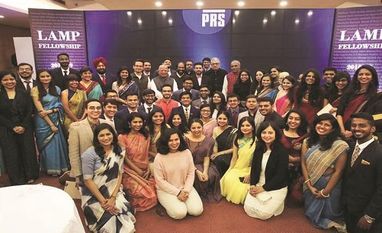 "LAMP: Glimpse of what goes into policy-making and the politics behind it")











