The world's largest and most powerful particle smasher Large Hadron Collider (LHC) has restarted circulating beams of protons for the first time this year, following a 17-week-long extended technical stop, CERN said.
Over the past month, after the completion of the maintenance work that began in December last year, each of the machines in the accelerator chain have been switched on and checked until last week when the LHC, the final machine in the chain, could be restarted.
"It is like an orchestra, everything has to be timed and working very nicely together," said Rende Steerenberg, who leads the operations group at the LHC.
"Once each of the parts is working properly, that is when the beam goes in, in phases from one machine to the next all the way up to the LHC," said Steerenberg.
Each year, the machines shut down over the winter break to enable technicians and engineers to perform essential repairs and upgrades, but this year the stop was scheduled to run longer, allowing more complex work to take place.
This year included the replacement of a superconducting magnet in the LHC, the installation of a new beam dump in the Super Proton Synchrotron (SPS) and a massive cable removal campaign.
Among other things, these upgrades will allow the collider to reach a higher integrated luminosity - the higher the luminosity, the more data the experiments can gather to allow them to observe rare processes.
Last year, the machine was able to run with stable beams - beams from which the researchers can collect data - for around 49 per cent of the time, compared to just 35 per cent the previous year.
The challenge the team faces this year is to maintain this or (preferably) increase it further.
The team will also be using the 2017 run to test new optics settings - which provide the potential for even higher luminosity and more collisions.
"We are changing how we squeeze the beam to its small size in the experiments, initially to the same value as last year, but with the possibility to go to even smaller sizes later, which means we can push the limits of the machine further," Steerenberg said.
"With the new SPS beam dump and the improvements to the LHC injector kickers, we can inject more particles per bunch and more bunches, hence more collisions," he said.
For the first few weeks only, a few bunches of particles will be circulating in the LHC to debug and validate the machine, according to CERN.
Bunches will gradually increase over the coming weeks until there are enough particles in the machine to begin collisions and to start collecting physics data.

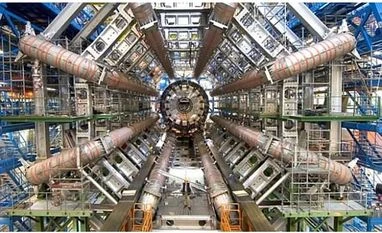 "Large Hadron Collider restarts for 2017 run: CERN")


 Connect with us on WhatsApp