Late rain revival helps narrow deficit, concerns remain
The revival, however, isn't enough to offset the rainfall deficiency in 31% of the country
Sanjeeb Mukherjee New Delhi Towards the end of the four-month southwest monsoon, rains have seen a revival, narrowing the cumulative national deficit to 11 per cent of the long-period average (the past 50-year average), as of Thursday.
The revival, however, isn’t enough to offset the rainfall deficiency in 31 per cent of the country. The deficiency primarily resulted from poor showers during the first 45 days of the monsoon. The deficit, 15 per cent on September 3, fell to 14 per cent on September 4 and 12 per cent on September 6. Since then, it has stood at about 11 per cent.
The India Meteorological Department (IMD) said in 17 regions of the country, the deficit was more than the national average.
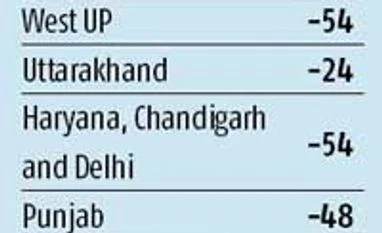
The worst-hit regions are Uttar Pradesh, Haryana, Punjab, Telangana and Maharashtra’s Marathwada region. In Punjab, the cumulative rainfall deficiency, as of Thursday, stood at 48 per cent; it was about 60 per cent 10 days earlier. During the same period, rainfall deficiency in Haryana fell from 60 per cent to 54 per cent. In Uttar Pradesh, Telangana and Marathwada, too, the deficiency narrowed. Rains in the week to Wednesday were 64 per cent above average, the highest this monsoon, IMD said on Thursday
The late monsoon showers have revived interest in sowing kharif crops. As of September 5, the area under kharif crops was just three per cent less than in the year-ago period. Compared to the corresponding period last year, the fall in the area under coarse cereals, pulses and oilseeds was the highest.
Experts remain divided over the impact of the late resurgence of the monsoon on the kharif crop. “I don’t think the loss to agriculture can be fully compensated by the late resurgence. In many pockets, 30-40 per cent of the area is still unsown. Therefore, to expect the monsoon showers will wipe off all woes is wrong,” said Mahesh Palawat, chief meteorologist of Skymet Weather Services, a private weather forecasting agency.
Ramesh Chand, director of the National Centre for Agriculture Economics and Policy Research, however, believes any amount of rain is good for agriculture, even if it is towards the end of the monsoon. "I agree the late showers won't bring things to normal and there will be some setback to production, but the situation on the ground is far better than a week ago," he said.
Withdrawal might start early next week: Skymet Withdrawal of the southwest monsoon might start early next week, weather forecasting agency Skymet has said. India Meteorological Department officials, however, did not confirm this. Skymet said the cyclonic weather, responsible for the current spell of rains in north India, would start weakening in the next two-three days. The southwest monsoon usually starts withdrawing from west Rajasthan on September 1.

 "Late rain revival helps narrow deficit, concerns remain")


 Connect with us on WhatsApp