Mattis seeks greater India role in Afghanistan, vows to fight terror havens

Indian and U.S. negotiators are now trying to move forward with a deal to supply the Indian navy with 22 Sea Guardian drone aircraft
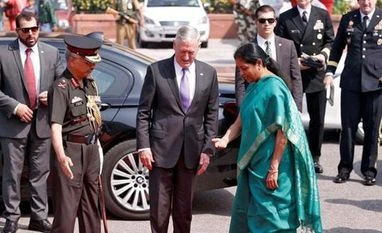
US seeks deeper ties with India amid China's military threats: Jim Mattis
Defence minister Nirmala Sitharaman receives US defense secretary Jim Mattis before their meeting in New Delhi on Tuesday. Photo: Reuters
Sanjeev Miglani
Last Updated : Sep 27 2017 | 8:15 AM IST
U.S. Defense Secretary Jim Mattis held talks with Indian leaders on Tuesday, vowing to jointly stamp out militant sanctuaries and seeking India’s greater involvement in helping to stabilise Afghanistan.

The comments come as President Donald Trump’s administration has stepped up pressure on Pakistan for more action against militant groups operating from its soil that are blamed for attacks in India and neighbouring Afghanistan.

Islamabad denies giving material support to the militants and instead accuses its arch-rival of trying to use Afghanistan as a base for anti-Pakistan activities.

But Mattis, the Trump administration’s first cabinet official to visit India, said the two countries would work together to fight terrorism.

“There can be no tolerance of terrorist safe havens,” he said in a statement. “As global leaders, India and the United States resolve to work together to eradicate this scourge.”

Washington welcomed Indian efforts to promote stability in Afghanistan, he added. New Delhi has committed $3 billion in development projects in Afghanistan and trains Afghan officers in India.

But it has not sent soldiers in the international effort to restore peace. “Our engagement in Afghanistan will continue, we shall expand our engagement,” Indian Defence Minister Nirmala Sitharaman said, following talks with Mattis.

Defence ties between India and the United States have expanded rapidly, with New Delhi buying U.S. weapons worth $15 billion over the last decade, moving away from traditional supplier Russia.

Military experts say U.S. weapons transfers aim at bolstering Indian capabilities to develop a counterweight against China’s growing assertiveness in recent years.

Indian and U.S. negotiators are now trying to move forward with a deal to supply the Indian navy with 22 Sea Guardian drone aircraft, whose June approval by the U.S. government was the first such clearance to a non-NATO ally.

India wants the unarmed drones to help its navy lengthen the duration of its surveillance in the Indian Ocean, where Chinese naval ships and submarines make regular forays.

Expanding naval cooperation with India was a top priority, Mattis said, adding that three-way exercises involving the United States, India and Japan boosted operational cooperation.

CHINA LOOMS LARGE

The United States has been critical of China’s build-up of military facilities in the South China Sea. But New Delhi turned down a U.S. suggestion of regional joint patrols with the Indian navy, for fear of a Chinese backlash.

“China looms very large for both countries,” said Dhruva Jaishankar, a specialist on India-U.S. relations at Brookings India.

“The strategic underpinning of India-US defence ties is in the common concerns they have over China, over its revisionism.”

The Indian air force has also asked for 90 armed Avenger Predator drones that experts say could be deployed for cross-border strikes, such as targeting militant camps India says exist on Pakistan’s side of disputed Kashmir.

Such a sale would need White House and Congress approval, sources said. But Pakistan and, possibly, China could see the move as de-stabilising.

Dronemaker General Atomics is pleased the Indian government has won approval for the surveillance version of the drone, said Vivek Lall, its chief executive for U.S. and international strategic development.

“Not only will this platform enhance India’s capabilities in the areas of maritime domain awareness and security, but the interoperability with one of the U.S.’s most important strategic partners will contribute to security across the region.”

The two sides will also discuss Lockheed Martin’s offer to build F-16 fighter planes in India as part of Prime Minister Narendra Modi’s drive to build a domestic military industrial base.

“We look forward to sharing some of our most advanced defence technologies,” Mattis said.

Sweden’s Saab is the other contender for the deal to supply at least 100 single-engine combat planes.

One subscription. Two world-class reads.

Already subscribed? Log in

Subscribe to read the full story →
*Subscribe to Business Standard digital and get complimentary access to The New York Times

Smart Quarterly

₹900

3 Months

₹300/Month

SAVE 25%

Smart Essential

₹2,700

1 Year

₹225/Month

SAVE 46%
*Complimentary New York Times access for the 2nd year will be given after 12 months

Super Saver

₹3,900

2 Years

₹162/Month

Subscribe

Renews automatically, cancel anytime

Here’s what’s included in our digital subscription plans

Exclusive premium stories online

  • Over 30 premium stories daily, handpicked by our editors

Complimentary Access to The New York Times

  • News, Games, Cooking, Audio, Wirecutter & The Athletic

Business Standard Epaper

  • Digital replica of our daily newspaper — with options to read, save, and share

Curated Newsletters

  • Insights on markets, finance, politics, tech, and more delivered to your inbox

Market Analysis & Investment Insights

  • In-depth market analysis & insights with access to The Smart Investor

Archives

  • Repository of articles and publications dating back to 1997

Ad-free Reading

  • Uninterrupted reading experience with no advertisements

Seamless Access Across All Devices

  • Access Business Standard across devices — mobile, tablet, or PC, via web or app

Next Story



