Prime Minister Narendra Modi will address a mass rally on a visit to Britain this week that supporters hope will help him spring back from a humiliating election loss and reassert his authority on the global stage.
India and Britain could announce deals worth 8-12 billion pounds ($12-$18 billion) during the visit, according to diplomats, with Modi keen to buy 20 more BAE Systems Hawk trainer aircraft to be made in Bengaluru.
Britain is home to an Indian diaspora of 1.5 million, and the two nations share the English language, historical ties and an obsession with cricket. Yet Modi has, in his first 18 months in power, made a priority of courting global powers like the US and China.
“UK-India ties are economically strong, but strategically weak,” said Shashank Joshi, a senior research fellow at the Royal United Services Institute in London.
Seeking to regain the initiative after crashing to defeat in a big state election at the weekend, Modi eased foreign investment rules this week in 15 sectors, including mining, defence and civil aviation.
“By introducing these reforms the government is certainly spelling out why India is an attractive destination,” said Nalin Kohli, a spokesman for Bharatiya Janata Party (BJP).
The centrepiece of the November 12-14 trip will be a mass rally and firework display at Wembley Stadium on Friday for an estimated 60,000 supporters — three times bigger than the crowd he drew to New York’s Madison Square Garden last year.
Yet Modi’s popularity is being challenged at home, after the BJP lost an election badly in Bihar, home to 104 million people. Three party elders, including former deputy prime minister LK Advani, released a statement late on Tuesday questioning the direction of the BJP, which risks embarrassing Modi just ahead of his visit.
British Prime Minister David Cameron is seeking to revamp economic ties with fast-growing Asian nations, including India, as part of his push on business-focused diplomacy.
Modi’s trip marks a remarkable turnaround for a man who was banned from Britain for 10 years over his alleged role as chief minister of Gujarat in riots that killed about 1,000 people in 2002.
Britain ended a boycott of Modi three years ago after he emerged from being a provincial politician to the likely leader of the world’s largest democracy. He has denied wrongdoing and was exonerated by an inquiry ordered by the Supreme Court.
His three-day visit is likely to be marked by protests over those riots and concerns over recent incidents in India where Muslims have been targeted by Hindu extremists.
Several groups were planning demonstrations outside Wembley Stadium during the rally and near Cameron’s Downing Street office to coincide with Modi’s visit there.
About 45 British lawmakers, including opposition leader Jeremy Corbyn, recently signed a parliamentary motion to debate India’s human rights record.
Modi has also attracted negative coverage in the British press, with the Left-leaning Guardian branding him a “divisive manipulator who charmed the world”.
The Financial Times predicted his visit would be overshadowed by troubles at home including “a surge of sometimes violent Hindu chauvinism and a slowdown of economic reform”.
However, many in Britain’s Indian diaspora were eager to celebrate Modi, with a website called “UK welcomes Modi” promising to deliver “the loudest, greatest and most vibrant welcome he has seen outside of India” at the Wembley rally.
Modi’s bilateral visit, the first by an Indian prime minister since 2006, follows a pomp-laden visit the British government gave China’s President Xi Jinping last month that yielded $62 billion of deals.
Britain has gradually lost ground to other nations in an effort to increase trade with its former colony. In 2000, it was India’s third-largest trading partner. Since then Britain has slipped to 18th, behind Belgium and Kuwait.
“There is a sense of things being jaded between the two countries,” said Neelam Deo, a former diplomat and director of Gateway House. “For India, Britain is a middle-ranking power — it doesn’t seem to have an independent foreign policy.”

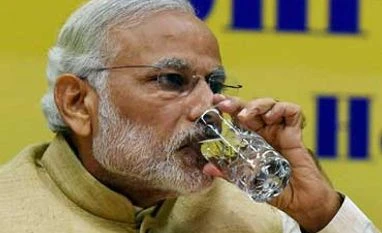 "Modi visits UK, seeks to bounce back from poll blow")


 Connect with us on WhatsApp