Home / India News / Mumbai records lowest level of noise pollution in 15 years during Diwali
Mumbai records lowest level of noise pollution in 15 years during Diwali
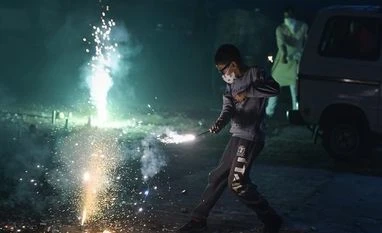
Mumbai recorded the lowest level of noise pollution in the last 15 years on the first day of Diwali festival during the permissible hours when the use of firecrackers was allowed, according to an NGO
In spite of these violations and the use of green firecrackers, the overall use of firecrackers was significantly less this time compared to previous years
of noise pollution in the last 15 years on the first day of Diwali festival on Saturday during the permissible hours when the use of firecrackers was allowed, according to an NGO.
Sumaira Abdulali, founder of Awaaz Foundation, told PTI on Sunday that the credit for the lowest levels of decibels (dB- the unit in which sound is measured) goes to the strict guidelines of the state government on bursting of firecrackers and growing awareness among citizens.
"The noise pollution level recorded during Diwali this year is the lowest in the last 15 years," Abdulali said.
In a statement, the NGO said the noise level was measured from 8 pm to 10 pm (on Saturday) and then until the next morning (Sunday).
The Brihanmumbai Municipal Corporation (BMC) had banned the use of firecrackers and fireworks in the city in a bid to check the spread of coronavirus.
"A noise level of 105.5 decibel (dB) was recorded just before the 10 pm deadline (for bursting firecrackers) at the Shivaji Park ground, a silence zone in the city," the Awaaz Foundation said.
"This is the first time since Shivaji Park was declared a silence zone by the Bombay High Court in 2010 that firecrackers were burst there during Diwali.
"The maximum noise levels (for Mumbai) stood at 112.3 dB in 2019, 114.1 dB in 2018, and 117.8 dB in 2017," the NGO said, adding that many people who had assembled at Shivaji Park didn't wear masks.
However, the NGO also added that the accurate measurement of decibels for the entire Mumbai is difficult.
"While the sound of bombs and other aerial firecrackers was audible in parts of the city. Their sound in residential societies cannot be measured," it stated.
The NGO said the BMC's ban on not bursting firecrackers after 10 pm was violated at some places in the city.
"However, in spite of these violations and the use of green firecrackers, the overall use of firecrackers was significantly less this time compared to previous years," it stated.
Mainly, less-noisy firecrackers like sparklers, fountains etc. were used this time, it said.
"I would like to thank citizens of Mumbai, the police and the state government for taking up the impossible challenge of reducing noise pollution in our city, one of the noisiest in the world.
"It was heartening to see the massive change brought about through active participation of all, which has succeeded in significantly reducing noise pollution from some of its most acute sources including during Ganpati, Eid-e-Milad and Diwali," Abdulali said.
(Only the headline and picture of this report may have been reworked by the Business Standard staff; the rest of the content is auto-generated from a syndicated feed.)

 "Mumbai records lowest level of noise pollution in 15 years during Diwali")


