
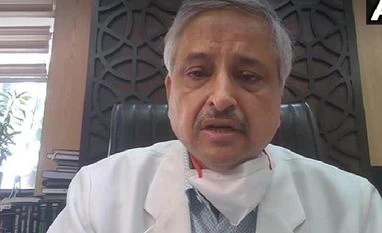
Need lockdown in areas with Covid positivity rate of over 10%: Guleria
Clamping such restrictions all over the country cannot be a solution, keeping in mind people's livelihood: Guleria
 "Need lockdown in areas with Covid positivity rate of over 10%: Guleria")
WebinarsNew
Deep DiveNew
Explore Business Standard
Clamping such restrictions all over the country cannot be a solution, keeping in mind people's livelihood: Guleria
A strict lockdown should be imposed in areas where the COVID-19 case positivity rate is over 10 per cent or the bed occupancy is above 60 per cent, AIIMS Director Dr Randeep Guleria said on Tuesday, while stressing that clamping such restrictions all over the country cannot be a solution, keeping in mind people's livelihood.
He rejected the strategy of imposing night curfews and weekend lockdowns by some states to reduce the number of coronavirus cases, saying "these would not have much of an impact on the transmission cycle".
"There is a need to impose strict regional lockdowns in areas where the COVID-19 case positivity rate is over 10 per cent or the bed occupancy is above 60 per cent to break the chain of transmission. The COVID-19task force has also been advising for the same.
"It is there in the guidelines of the home ministry, but it is not being strictly implemented," Guleria told PTI.
He said there should be a gradual, graded unlocking in such areas once the positivity rate reduces.
However, he stressed that there should be restrictions on people travelling from areas that have a high positivity rate to places with a low positivity rate to curb the spread of the infection.
On his views about a nationwide lockdown, Guleria said, "A complete national lockdown cannot be a solution, keeping in mind people's livelihoods and the impact it will have on daily wage labourers. Day-to-day activities in areas with a low positivity rate should be allowed with restrictions."
Aggressive containment measures have to be put in place for a sufficient period of time as no healthcare infrastructure can manage this kind of a caseload, he stated.
Guleria's remarks come in the backdrop of the country facing a serious COVID-19 crisis with a spike in the numbers of cases and deaths, and hospitals running out of oxygen and beds.
India's COVID-19 tally has crossed the grim milestone of two crore with over 50 lakh cases recorded in just 15 days.
It has mounted to 2,02,82,833 with 3,57,229 fresh cases reported in a day, while the death toll due to the viral disease has climbed to2,22,408 with 3,449 more people succumbing to it, the health ministry said on Tuesday.
(Only the headline and picture of this report may have been reworked by the Business Standard staff; the rest of the content is auto-generated from a syndicated feed.)
First Published: May 04 2021 | 7:41 PM IST

