
Need to make our growth much more equitable: Niti Aayog's Rajiv Kumar
The country needs much more 'equitable' growth as inequality could lead to tensions in society, Niti Aayog Vice-Chairman Rajiv Kumar said on Thursday.
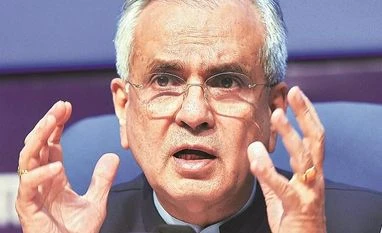 "Need to make our growth much more equitable: Niti Aayog's Rajiv Kumar")
WebinarsNew
Deep DiveNew
Explore Business Standard
The country needs much more 'equitable' growth as inequality could lead to tensions in society, Niti Aayog Vice-Chairman Rajiv Kumar said on Thursday.
The country needs much more 'equitable' growth as inequality could lead to tensions in society, Niti Aayog Vice-Chairman Rajiv Kumar said on Thursday.
Kumar further said the country's democracy will not permit the kind of K-shaped growth it has seen in the past, where different sections of the population have been growing at different paces.
"Within India, growing inequality will sooner rather than later create tensions and problems in our society which we will not be able to bear. We need to find ways now to make our growth much more equitable," Kumar said at an event organised by the Bombay Chamber of Commerce and Industry.
The equitable growth should be the one which can empower people and give them the right opportunity to excel, he emphasised.
Kumar said there is an expectation that the economy will grow at 9.2 per cent this fiscal, 8.5 or 8.7 per cent in FY2023 and 7.5 per cent after that, making it one of the fastest growing economies in the world.
"The question we need to ask is will that be good enough to meet the aspiration of our young population, to meet their ambition...this is not enough," he said.
The challenge, he said, is to break through growth barriers soon.
"It is not simple but also not impossible. We need to have consistent, rapid and double-digit growth for the next two or three decades which will help us use our demographic dividend and also help us prevent our demographic dividend from turning into a waste and becoming difficult to handle," he pointed out.
However, Kumar added that the growth which the country wants to achieve should not be at the cost of the environment.
"We have to complete our economic transition in a manner that is green transition. It is a huge challenge again because very often in the past this has been seen as a trade-off between growth and environment, but we can't see it as a trade-off. We have to find ways and means to make it happen together," he said.
According to Kumar, the private sector investment will be the driver of growth in the country going ahead.
(Only the headline and picture of this report may have been reworked by the Business Standard staff; the rest of the content is auto-generated from a syndicated feed.)
First Published: Jan 13 2022 | 8:02 PM IST


 Connect with us on WhatsApp