The NSEL Investors Forum has written to consulting firm Ernst & Young's (EY’s) global head, seeking compensation for their losses in the Rs 5,600-crore National Spot Exchange payment crisis.
This is the latest move in the investors’ campaign against the auditors and consultants of NSEL, following the registration of criminal complaints with the Mumbai Police’s economic offences wing and with the Union ministry of corporate affairs.
The campaign has gained strength after reports said the Arvind Mayaram panel, appointed by the central government to probe the crisis, made a reference to shoddy due diligence by the auditors.
| QUERYING EY’S RISK ASSESSMENT |
- NSEL investors seek compensation for their losses from EY global chairman and CEO
- EY Report to Geojit has certain assertions, which have been challenged subsequently
- Report based on publicly available statements and legal framework put out by NSEL
- Report also highlights several regulatory risks on paired trades and rates these as high
- However, the report commissioned by Geojit was not addressed to investors
|
In a letter dated October 31, addressed to Mark Weinberger, the firm’s US-based chairman, the Forum said: "We are firmly of the view that EY is equally responsible for the loss caused to these hapless investors, by their acts of conveniently omitting crucialand damaging facts about the business practices employed by the promoters of NSEL. Therefore, it is also the liability of EY to compensate the aggrieved investors, now that the bubble has burst."
Investors have pointed to some incorrect assertions by EY’s financial risk services, in a report titled ‘Risk-based review of commodity financing business”.
The September 2012 report, commissioned by Geojit Comtrade, a broker which traded on NSEL, pointed to various risks and suggested measures to Geojit.
An EY spokesperson said, “We categorically deny any allegations of wrongdoing and collusion. These allegations are incorrect and out of context. We are confident of the quality of our work and confirm that the report prepared by Ernst & Young Pvt Ltd (now Ernst & Young LLP) on commodities financing in India articulates the regulatory environment and clearly explains the key risks associated with the commodities financing business in India. The report must be read in totality, to gain a complete view of our assessment and recommendations thereof. We are bound by our confidentiality agreement with our client and are, therefore, unable to provide any further comments.”
Investors also took exception to the fact that an EY associate was the statutory auditor of NSEL in the year immediately preceding the risk assessment report. To this, the EY spokesperson said, “Ernst & Young LLP and SV Ghatalia and Associates (SVGA) LLP are independent firms. The above-mentioned advisory report on commodities financing in India has no relationship whatsoever with the statutory audit of NSEL done by SVGA. Further, the advisory report on commodities financing was issued in September 2012, during the financial year 2012-2013, and SVGA was not the statutory auditor of NSEL's financial statements for that year.”
A copy of the report commissioned by Geojit, reviewed by Business Standard, showed one of the actionable items recommended by EY was “Regular audit by Geojit of the warehoused commodities.” It said any additional cost incurred for this should be passed on to the investor.
It also pointed to several regulatory risks and rated these “high.”
But investors say the report gave some misleading assertions while detailing the exchange’s infrastructure under the head ‘assessment of NSEL Infrastructure and set-up’. Under this, the EY report said all NSEL warehouses were accredited under the central warehousing regulator, WDRA. However, none of the warehouses were registered with WDRA. The EY report to Geojit , however, pointed to “absence of enforcement agencies for compliance of WDRA.” It added that there was a “contingent financial risk on account of potential for fraud”.
Second, under the parameter of “risk management”, the report said there was “daily mark to market of open positions. Margin call issued in case of breach of predefined limits”. It is clear from recent forensic audits and the showcause notices issued by the Forward Markets Commission (Business Standard has reviewed these) that the exchange, in fact, did not implement any mark to market mechanism (revluation of assets based on current values) on the trades.
Further, under the head ‘clearing and settlement mechanism’ EY srated there was “limited counterparty risk for the company (Geojit) on account of robust risk management framework adopted by the exchange for clearing and settlement of trades”. NSEL investors point out that NSEL did not have proper risk management. The showcause notice issued by FMC said, “In practice, NSEL had not adopted adequate risk management measures and also compromised on its actual implementation.”
EY seems to have prepared the risk assessment for the limited use of Geojit’s business and based on terms of reference given to it. Many of the assessments in the EY report were based on the framework of rules, bylaws and circulars put out by NSEL. The report did not do physical checks on whether these rules and laws were actually followed or implemented by the exchange or not.
In a letter accompanying the report, EY’s Muzammil Patel said “This report is intended solely for the information and use of management of Geojit Comtrade.”

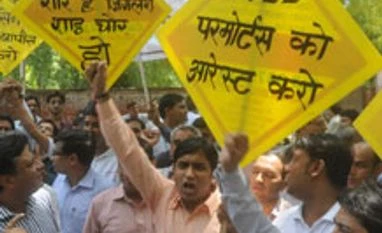 "NSEL investors seek compensation from EY")


 Connect with us on WhatsApp