On brink of 'Emergency': Delhi-NCR air quality index season's worst at 471

People advised to limit outdoor activities, offices told to cut vehicle use by 30%
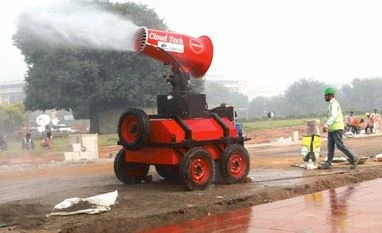
Delhi Pollution
A worker is seen next to an anti-smog gun near the ongoing redevelopment project on Rajpath, in New Delhi on Friday (Photo: Reuters)
Press Trust of India New Delhi
3 min read Last Updated : Nov 13 2021 | 12:22 AM IST
Authorities on Friday advised people to limit outdoor activities and told government and private offices to cut vehicle use by at least 30 per cent as air quality in Delhi-NCR inched towards the emergency level amid a rise in emissions from farm fires and unfavourable meteorological conditions.

Over 4,000 farm fires, accounting for 35 per cent of Delhi's pollution on Friday, played a major role in pushing the 24-hour average Air Quality Index (AQI) to 471 by 4 pm, the worst this season so far. It was 411 on Thursday. A sub-committee on Graded Response Action Plan (GRAP) said meteorological conditions will be highly unfavourable for dispersion of pollutants till November 18 and agencies concerned must be fully ready to implement measures under 'emergency' category.

The Central Pollution Control Board (CPCB) said the 24-hour average concentration of lung-damaging fine particles known as PM2.5 in Delhi-NCR crossed the 300 mark around midnight and stood at 381 micrograms per cubic metre at 4 pm on Friday, over six times the safe limit of 60 micrograms per cubic metre. The PM10 level was recorded at 577 micrograms per cubic metre, over five times the safe limit of 100 micrograms per cubic metre.

According to GRAP, the air quality is considered to be in the 'emergency' category if the PM2.5 and PM10 levels continue to be above 300 micrograms per cubic metre and 500 micrograms per cubic metre respectively for 48 hours or more.

After reviewing the situation, the sub-committee on GRAP said, "Government and private offices and other establishments are advised to reduce vehicle usage by at least 30 per cent (by working from home, carpooling, optimising field activities etc). People are advised to limit outdoor activities and minimise their exposure.” “Concerned agencies must be in complete readiness for implementation of measures under 'emergency' category as per GRAP (Graded Response Action Plan)," an order issued by the committee read.

The GRAP — a set of anti-pollution measures followed in Delhi and its vicinity according to the severity of the situation – comes into force in mid-October when air quality levels start worsening. The measures to be followed in the 'emergency' situation include stopping the entry of trucks in Delhi, ban on construction activities and introducing the odd-even car rationing scheme.CPCB Member Secretary Prashant Gargava observed that in view of unfavourable meteorology, stubble burning and poor dispersion resulting in accumulation of pollutants, the coming week is critical for the air quality of Delhi and the entire NCR's.  

The CPCB said an action-taken report is received daily from Uttar Pradesh and Haryana Pollution Control Boards but these are awaited from Delhi Pollution Control Committee and Rajasthan State Pollution Control Board. According to an analysis by the Delhi Pollution Control Committee, people in Delhi breathe the worst air between November 1 and November 15 every year. The city has recorded severe air quality on six of the last eight days after Diwali.

Faridabad (460), Ghaziabad (486), Greater Noida (478), Gurgaon (448) and Noida (488) also recorded severe air quality at 4 pm on Friday. An AQI between zero and 50 is considered "good", 51 and 100 "satisfactory", 101 and 200 "moderate", 201 and 300 "poor", 301 and 400 "very poor", and 401 and 500 "severe". A layer of smog lingering over Delhi-NCR thickened on Friday, giving an orange tint to the sun and lowering visibility to 200 metres in the region.

One subscription. Two world-class reads.

Already subscribed? Log in

Subscribe to read the full story →
*Subscribe to Business Standard digital and get complimentary access to The New York Times

Smart Quarterly

₹900

3 Months

₹300/Month

SAVE 25%

Smart Essential

₹2,700

1 Year

₹225/Month

SAVE 46%
*Complimentary New York Times access for the 2nd year will be given after 12 months

Super Saver

₹3,900

2 Years

₹162/Month

Subscribe

Renews automatically, cancel anytime

Here’s what’s included in our digital subscription plans

Exclusive premium stories online

  • Over 30 premium stories daily, handpicked by our editors

Complimentary Access to The New York Times

  • News, Games, Cooking, Audio, Wirecutter & The Athletic

Business Standard Epaper

  • Digital replica of our daily newspaper — with options to read, save, and share

Curated Newsletters

  • Insights on markets, finance, politics, tech, and more delivered to your inbox

Market Analysis & Investment Insights

  • In-depth market analysis & insights with access to The Smart Investor

Archives

  • Repository of articles and publications dating back to 1997

Ad-free Reading

  • Uninterrupted reading experience with no advertisements

Seamless Access Across All Devices

  • Access Business Standard across devices — mobile, tablet, or PC, via web or app

Topics :Air Quality IndexDelhi air qualityDeli air pollution

Next Story


