
Over 270 mn people in India moved out of poverty between 2005-16: Report
While there is much that needs to be done to tackle poverty globally, there are "promising signs that such poverty can be - and is being - tackled", says the report
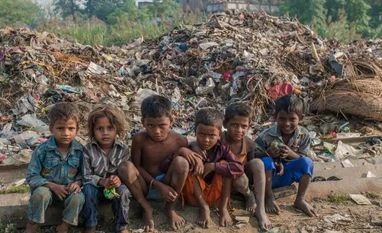 "Over 270 mn people in India moved out of poverty between 2005-16: Report")
Explore Business Standard
While there is much that needs to be done to tackle poverty globally, there are "promising signs that such poverty can be - and is being - tackled", says the report
Over 270 million people in India moved out of poverty in the decade since 2005-06 and the poverty rate in the country nearly halved over the 10-year period, a promising sign that poverty is being tackled globally, according to latest estimates released Thursday.
The 2018 global Multidimensional Poverty Index (MPI) released here by the United Nations Development Programme (UNDP) and the Oxford Poverty and Human Development Initiative (OPHI) said that about 1.3 billion people live in multidimensional poverty globally.
This is almost a quarter of the population of the 104 countries for which the 2018 MPI is calculated. Of these 1.3 billion, almost half - 46 per cent - are thought to be living in severe poverty and are deprived in at least half of the dimensions covered in the MPI, it said.
While there is much that needs to be done to tackle poverty globally, there are "promising signs that such poverty can be - and is being - tackled."
The Index noted that in India, 271 million people moved out of poverty between 2005/06 and 2015/16. The poverty rate in the country has nearly halved, falling from 55 per cent to 28 per cent over the ten-year period.
India is the first country for which progress over time has been estimated.
"Although the level of poverty particularly in children is staggering so is the progress that can be made in tackling it. In India alone some 271 million have escaped multidimensional poverty in just ten years," UNDP Administrator Achim Steiner said.
"The Multidimensional Poverty Index gives insights that are vital for understanding the many ways in which people experience poverty, and it provides a new perspective on the scale and nature of global poverty while reminding us that eliminating it in all its forms is far from impossible," he said.
Although similar comparisons over time have not yet been calculated for other countries, the latest information from UNDP's Human Development Index shows significant development progress in all regions, including many Sub-Saharan African countries.
Between 2006 and 2017, the life expectancy increased over seven years in Sub-Saharan Africa and by almost four years in South Asia, and enrollment rates in primary education are up to 100 per cent.
This bodes well for improvements in multidimensional poverty.
The estimates further showed that half of all people living in poverty are younger than 18 years old. The new figures show that in 104 primarily low and middle-income countries, 662 million children are considered multidimensionally poor.
In 35 countries half of all children are poor. The MPI looks beyond income to understand how people experience poverty in multiple and simultaneous ways.
It identifies how people are being left behind across three key dimensions: health, education and living standards, lacking such things as clean water, sanitation, adequate nutrition or primary education.
Those who are deprived in at least of a third of the MPI's components are defined as multidimensionally poor.
The 2018 figures, which are now closely aligned with the Sustainable Development Goals, cover almost three-quarters of the world's population.
Multidimensional poverty is found in all developing regions of the world, but it is particularly acute and significant in Sub-Saharan Africa and South Asia.
In Sub-Saharan Africa, about 560 million people (58 percent of the population) are living in multidimensional poverty, 342 million (61 per cent of those living in multidimensional poverty) of them severely so.
While in South Asia 546 million people (31 per cent of the population) are multidimensionally poor, 200 million of them (37 per cent) severely so.
Figures for the other regions are less severe and range from 19 per cent of people in the Arab States living in multidimensional poverty, to two per cent of those living in countries covered by the dataset in Europe and Central Asia.
Within countries there is also considerable disparities. The 2018 MPI is available for 1,101 subnational regions showing within-country variations in multidimensional poverty levels for 87 countries.
The latest data also reveals the vast majority 1.1 billion of the multidimensional poor live in rural areas around the world, where poverty rates, at 36 per cent, are four times higher than among those living in urban areas.
"The Multidimensional Poverty Index is a powerful tool for examining global poverty and communicating useful facts. Not only does it allow us to understand how different countries are faring in their fight against poverty, but it helps us to better understand who the poor are, where they are and the many different ways in which they experience poverty, OPHI Director Sabina Alkire said.
Traditional poverty measures often calculated by numbers of people who earn less than $ 1.90 a day shed light on how little people earn but not on whether or how they experience poverty in their day-to-day lives. The MPI provides a complementary picture of poverty and how it impacts people across the world.
While the MPI's core data look at those who are poor, and the subset who are severely poor, the numbers also look at those very close to becoming poor. These people, while not quite multidimensionally poor, are living precariously and struggling to remain above the poverty line.
First Published: Sep 20 2018 | 8:00 PM IST

