Rs 2,000-cr roadmap to end stubble burning submitted at SC
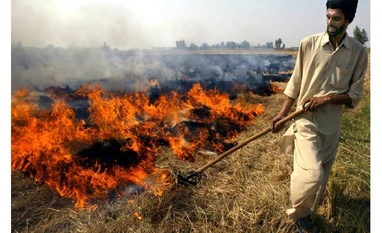
According to official estimates, over 30 million tonnes of paddy straw are annually generated in Punjab and Haryana, which are later set to fire by farmers.
Press Trust of India New Delhi A Rs 2,000-crore road map to end stubble burning in Punjab and Haryana suggests that the government must provide equipment to farmers for free instead of subsidies, and the cost be recovered by imposing cess on sale of petrol and diesel in Delhi.
According to the plan, submitted to the Supreme Court by an amicus curiae in an ongoing case related to air pollution, the best solution to avoid burning of crop residue is to till the straw back into the field using certain machines.
According to official estimates, over 30 million tonnes of paddy straw are annually generated in Punjab and Haryana, which are later set to fire by farmers to reduce the turnaround time between harvesting paddy and sowing wheat crop.
"The Centre and state governments must provide machines free of cost to farmers to use. This requires large-scale governmental procurement of the agricultural equipment, which should be given to every panchayat for common use," says the report.
It says the most promising technologies in this area are Turbo Happy Seeder (THS), which allows for seeding without till and the Super Straw Management System (S-SMS), developed by Punjab Agricultural University, which provides for the straw to be spread on the field.
The seasonal burning of paddy straw in Punjab and Haryana aggravates pollution in Delhi every winter. The issue has turned political in the recent years with the neighbouring governments indulging in blame game over it.
Earlier this month, pollution in the city hit emergency levels due to the traditional practice as smoke-laden winds from that region had shrouded Delhi in a thick blanket of smog.
Harish Salve, the amicus curiae who works closely with the Environment Pollution (Prevention and Control) Authority or EPCA, submitted the plan to the apex court on November 17.
"The THS and S-SMS each cost between Rs 1.2 and 1.5 lakh. Given that there are roughly 13,000 panchayats in Punjab and some 6,500 in Haryana, if even three sets of these machines are given free to each panchayat, it would only require some Rs 2,000 crore to be spent in Punjab and Haryana (Punjab would need Rs 1,300 and Haryana Rs 650 crore)," it says.
The amount should be generated by imposing a pollution charge on the sale of petrol and diesel in Delhi, which will also help in reducing the differential between the prices of petrol and diesel, which continues to remain at about Rs 10 per litre because of taxes, the proposal says.
Currently, Delhi consumes 10 lakh tonnes of petrol and 13 lakh tonnes of diesel annually (2016-17). If a cess of Rs 1 is imposed on petrol and Rs 5 on diesel per litre, then the city alone will contribute Rs 900 crore in one year.
The report terms as "perverse" the suggestion that farmers be provided subsidies to dissuade them from burning crop residues.

 "Rs 2,000-cr roadmap to end stubble burning submitted at SC")


 Connect with us on WhatsApp