Last week, DDCA sued AAP leader and Delhi CM Arvind Kejriwal for defamation, seeking damages of Rs 2.5 crore
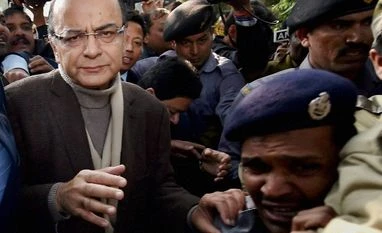
Finance Minister Arun Jaitley arrives to file a defamation case against Delhi CM Arvind Kejriwal and other Aam Aadmi Party leaders for their DDCA corruption allegations against him, in New Delhi
There have been several instances in the past of party leaders, listed companies and even stock exchanges resorting to defamation suits. The damages claimed have been as high as Rs 5,000 crore, in a recent case slapped by a utility company on a newspaper
Last week, Delhi & District Cricket Association (DDCA ) sued Aam Aadmi Party leader and Delhi chief minister Arvind Kejriwal for defamation, seeking damages of Rs 2.5 crore. Also, former cricketer and Kirti Azad, MP, for an identical sum for alleging various irregularities.
Earlier, Union finance minister Arun Jaitley had filed a civil defamation suit in the Delhi high court on Kejriwal and AAP leaders for broadly the same allegations. However, he claimed damages of Rs 10 crore. Separately, a criminal defamation charge was filed in a city court. Reports have it that the minister had filed these cases in his personal capacity and would not be using the government’s law officers and resources, though these would have been available to him. Jaitley’s cases refer to defamation done by the defendants through Twitter, Facebook posts and press articles.
There have been several instances in the past of party leaders, listed companies and even stock exchanges resorting to defamation suits. The damages claimed have been as high as Rs 5,000 crore, in a recent case slapped by a utility company on a newspaper.
However, the DDCA matter has thrown up a novel instance where for the same set of allegations, Jaitley is claiming four times the damages claimed by DDCA. Was he defamed more? It is possible to argue that the real target of Kejriwal was Jaitley, while DDCA was only an excuse, to borrow the Delhi CM’s favourite ‘Bahana-Nishana’ analogy.
But, how were these sums arrived at? Legal experts and publications suggest multiple ‘methods’ to calculate damages; no method is specified by the law itself. There can be compensatory and punitive damages and a claim can comprise both. In a post titled ‘Calculating damages in defamation’, US lawyer Amir Tikriti breaks this down a bit and brings in the economics part.
“Calculating damages,” said his post, “depends heavily on the facts of your particular case. Usually, plaintiffs will engage an expert in economics to perform an economic damage analysis. With respect to losses to the plaintiff’s business or profession, the damages suffered are usually measured by the difference in the plaintiff’s actual earnings from the projected earnings, but for the defendant’s actions.”
Tikriti also explains how the economics expert would proceed. The first step is to project the plaintiff’s revenue, based upon life expectancy and retirement age. Historical earnings are used to calculate the future revenue and earnings, based upon plaintiff’s damaged reputation, and compare that data to the revenues and earnings projection as if no damage had been done. The plaintiff’s income tax returns, the state of the economy, state of the sector and peer group comparisons are factors that go into these calculations.
It is not clear if civil defamation suits in India, especially those slapped by corporations to shock and suppress publications and whistleblowers from communicating their misdeeds to their stakeholders, follow these rigorous methods in calculating the damages claimed. Ironically, the corporate balance sheet, a part of which belongs to the stakeholders, is used to fund such suits.
They seem keen to beat their own dubious records in claiming damages and using these never-ending cases as levers to influence the defendants. In most places, the damages are capped only by the plaintiff’s ability to pay the stamp duty of one per cent.
Thus, the system is not very fair to people with limited resources. The law should prescribe an appropriate method of calculating damages, so that it is applied in a just and equitable manner to all sections of society.

 "Some are more defamed than others")


 Connect with us on WhatsApp