StatsGuru: Second Covid wave ominously worse than the first in India

The 14-day average of new daily cases has risen from the low of about 1500 to over 5000 in less than a month, about four times fast than the time taken for this jump in the first wave

Coronavirus testing
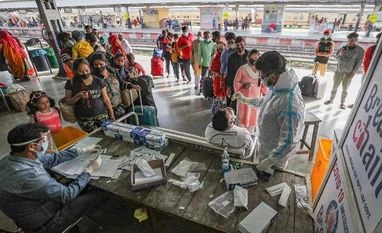
A medic takes swab samples from passengers for COVID-19 tests, at Jammu Railway station
Abhishek Waghmare
4 min read Last Updated : Mar 21 2021 | 10:33 PM IST
More than a year into the coronavirus pandemic, India's reasons to celebrate are waning and worries are rising by the day. In the two hardest-hit districts, Pune and Mumbai, the second wave is significantly more potent than the first, shows chart 1.


The 14-day average of new daily cases has risen from the low of about 1,500 to over 5,000 in less than a month, about four times fast than the time taken for this jump in the first wave. This may even worsen from here on. 

Now these two cities were the reason for Maharashtra being the most affected in the first wave. In the second wave, even rest of Maharashtra is on a worse trajectory, with the speed three times faster than the first wave, reveals chart 2. 


The worsening spread in Maharashtra makes the second wave in the country as a whole look milder. It took five weeks to take the 14-day average of new national cases to 28,000 this time, compared to four weeks in the first wave, shows chart 3. But daily cases are rising fast, and pointing to a worse outcome. 


Now, seroprevalence studies have shown that only one in five Indians were infected, and four in five still remained susceptible to infection as we entered 2021. To achieve herd immunity, rapid vaccination is the only hope. 

Chart 4 illustrates that India is still way behind other countries in vaccination (doses administered per million). Though the caseload per million people is low in India compared to other countries, testing prevalence is also low. A worrisome fact is that India has the highest number of critical Covid-19 cases in the world. 
 

On this note, chart 5 shows which states would get close to herd immunity fast, and which ones would take years if they continue with the current weekly rate of inoculation. While Kerala and Rajasthan may make it the fastest, states such as Bihar and Assam may take as long as 2024 to vaccinate half the population at the current weekly rate. Maharashtra may not be able to vaccinate half of its population by middle of 2022 at its current rate. 


The analysis assumes that 50% of the population is inoculated if the number of doses administered is equal to the population.

StatsGuru is a weekly feature. Every Monday, Business Standard guides you through the numbers you need to know to make sense of the headlines; Source: covid19india.org, Our World In Data, worldometers.info, UIDAI


One subscription. Two world-class reads.

Already subscribed? Log in

Subscribe to read the full story →
*Subscribe to Business Standard digital and get complimentary access to The New York Times

Smart Quarterly

₹900

3 Months

₹300/Month

SAVE 25%

Smart Essential

₹2,700

1 Year

₹225/Month

SAVE 46%
*Complimentary New York Times access for the 2nd year will be given after 12 months

Super Saver

₹3,900

2 Years

₹162/Month

Subscribe

Renews automatically, cancel anytime

Here’s what’s included in our digital subscription plans

Exclusive premium stories online

  • Over 30 premium stories daily, handpicked by our editors

Complimentary Access to The New York Times

  • News, Games, Cooking, Audio, Wirecutter & The Athletic

Business Standard Epaper

  • Digital replica of our daily newspaper — with options to read, save, and share

Curated Newsletters

  • Insights on markets, finance, politics, tech, and more delivered to your inbox

Market Analysis & Investment Insights

  • In-depth market analysis & insights with access to The Smart Investor

Archives

  • Repository of articles and publications dating back to 1997

Ad-free Reading

  • Uninterrupted reading experience with no advertisements

Seamless Access Across All Devices

  • Access Business Standard across devices — mobile, tablet, or PC, via web or app

Topics :CoronavirusMaharashtraStatsGuruIndiaKeralarajasthan

Next Story